
Abstract
This comprehensive guide explores the εσωτερικό-εξωτερικό μονάδα μεμβράνης UF designed for industrial water treatment applications. As global water scarcity intensifies and regulatory standards tighten, industries require advanced filtration technologies that deliver consistent performance, operational efficiency, and long-term cost savings. The εσωτερικό-εξωτερικό μονάδα μεμβράνης UF represents a proven solution for removing suspended solids, bacteria, viruses, and colloidal particles from process water and wastewater streams. This article examines the technical specifications, operational principles, compliance standards, and commercial advantages of inside-out UF membrane modules. Procurement managers, process engineers, and facility planners will find practical guidance for evaluating membrane module configurations, assessing the total cost of ownership, and selecting suppliers capable of delivering customized ultrafiltration solutions for pharmaceutical manufacturing, electronics production, municipal water reclamation, and industrial wastewater treatment applications.
What is Inside-Out UF Membrane Technology?
Operating Principle of Inside-Out Flow Configuration
The εσωτερικό-εξωτερικό μονάδα μεμβράνης UF utilizes a flow configuration where feed water enters the hollow fiber lumen (the interior channel of the membrane fiber) under pressure. As water flows through the fiber’s interior, it permeates radially outward through the membrane wall to the shell side, where filtered permeate is collected. This configuration operates in either dead-end or cross-flow modes depending on application requirements.
In dead-end filtration, all feed water passes through the membrane, with contaminants accumulating on the lumen surface. This mode maximizes water recovery rates (typically 90-98%) and suits applications with moderate fouling potential. Cross-flow mode maintains a tangential flow along the fiber lumen, creating shear forces that minimize concentration polarization and extend filtration cycles between cleanings. The εσωτερικό-εξωτερικό μονάδα μεμβράνης UF design concentrates rejected particles within the fiber lumen, facilitating efficient removal during backwash cycles.
The hydraulic advantage of inside-out flow lies in the pressure distribution. Feed water under 1-3 bar pressure enters the fiber lumen, where the smaller internal diameter creates a higher linear velocity compared to outside-in configurations. This velocity generates turbulence that reduces particle deposition and maintains higher flux rates over extended operating periods. During backwash, permeate flows from the shell side back through the membrane into the lumen, where concentrated contaminants are flushed to waste through the feed inlet line. For this reason, the εσωτερικό-εξωτερικό μονάδα μεμβράνης UF is preferred in high-turbidity applications.
Key Structural Components and Materials
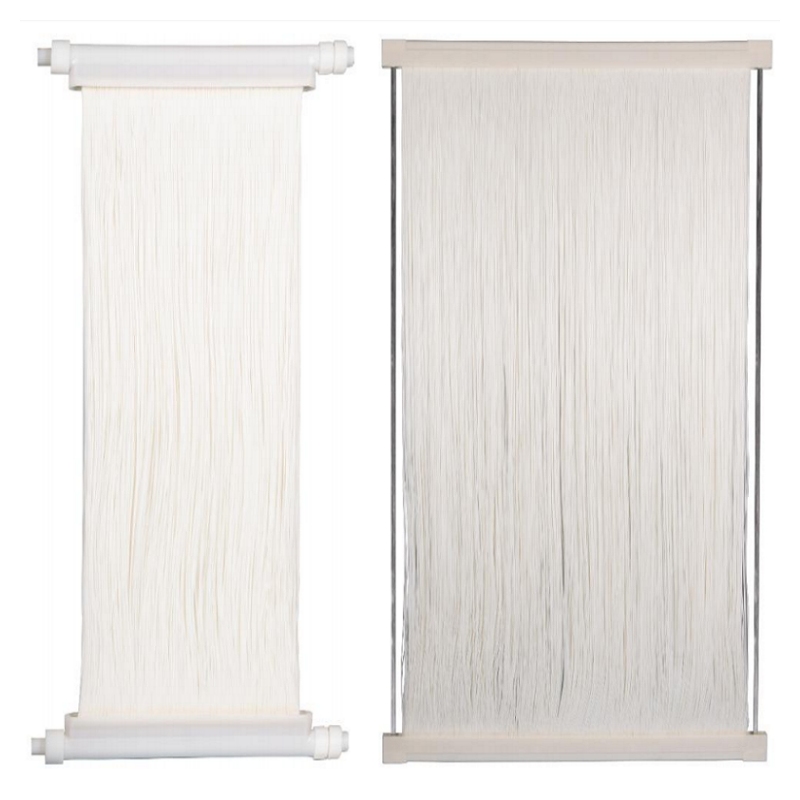
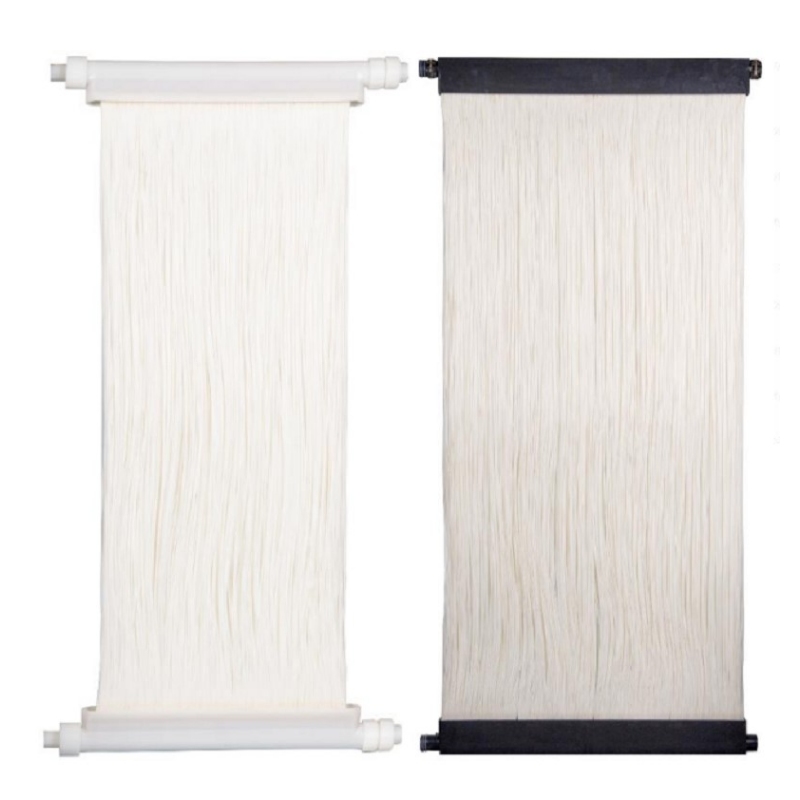
Modern inside-out UF membrane modules employ hollow fiber membranes manufactured from thermoplastic polymers selected for chemical resistance, mechanical strength, and hydrophilicity. Polyvinylidene fluoride (PVDF) dominates industrial applications due to its exceptional chemical stability across pH 2-12, chlorine tolerance up to 500 ppm, and operating temperature range of 5-40°C. PVDF membranes demonstrate superior fouling resistance and cleanability, extending operational lifespan to 7-10 years in properly maintained systems.
Polyethersulfone (PES) membranes offer high hydrophilicity and excellent biocompatibility, making them preferred for pharmaceutical and food-grade applications requiring FDA compliance. PES exhibits lower protein adsorption compared to PVDF, reducing organic fouling in biopharmaceutical processing. Polyacrylonitrile (PAN) provides the highest hydrophilicity among UF membrane materials, though limited chemical resistance restricts its use to neutral pH applications. Each εσωτερικό-εξωτερικό μονάδα μεμβράνης UF type offers distinct advantages depending on the feed water chemistry.
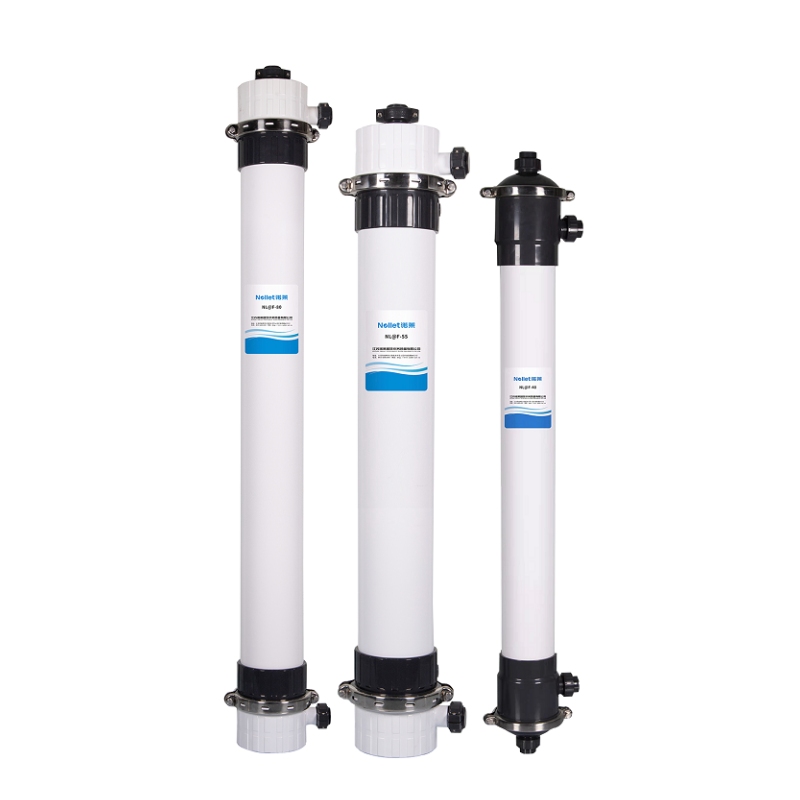
The module housing typically consists of pressure-rated PVC, stainless steel (304/316L), or fiberglass-reinforced plastic (FRP) designed for working pressures of 4-6 bar. Housing diameters range from 4-12 inches with lengths of 40-60 inches, accommodating membrane surface areas from 40-80 m² per εσωτερικό-εξωτερικό μονάδα μεμβράνης UF. Critical design elements include:
-
Potting compound: Epoxy or polyurethane resin encapsulates fiber ends, creating a leak-proof barrier between feed and permeate zones while maintaining individual fiber integrity
-
End caps: Threaded or flanged connections facilitate module installation and replacement
-
Vent ports: Allow air purging during startup and chemical cleaning procedures
-
Pressure taps: Enable differential pressure monitoring for fouling detection
Fiber inner diameters typically measure 0.5-1.0 mm with wall thicknesses of 100-200 μm, providing mechanical strength to withstand backwash pressures while maintaining high packing densities of 800-1200 m²/m³. A well-designed εσωτερικό-εξωτερικό μονάδα μεμβράνης UF maximizes surface area while minimizing hydraulic resistance.
Technical Specifications and Performance Parameters
Filtration Performance Metrics
Inside-out UF membrane modules achieve molecular weight cut-off (MWCO) values between 50,000-500,000 Daltons, corresponding to pore sizes of 0.01-0.1 μm. This pore size range provides absolute retention of bacteria (>6-log removal), viruses (>4-log removal), and colloidal particles while allowing dissolved salts, minerals, and small organic molecules to pass through. Turbidity reduction consistently achieves <0.1 NTU from feed waters containing 20-50 NTU, meeting stringent process water specifications for semiconductor manufacturing and pharmaceutical applications.
Permeate flux rates vary with feed water characteristics, operating pressure, and membrane material. Typical performance ranges for an εσωτερικό-εξωτερικό μονάδα μεμβράνης UF include:
-
Clean water flux: 80-150 LMH (liters per square meter per hour) at 1 bar transmembrane pressure
-
Operating flux: 40-80 LMH under normal industrial conditions
-
Critical flux: 60-100 LMH, representing the maximum sustainable flux before irreversible fouling accelerates
Operating pressure requirements remain economical at 0.5-2.5 bar for most industrial applications, significantly lower than reverse osmosis systems. This pressure range translates to specific energy consumption of 0.1-0.3 kWh/m³ for the membrane separation process, excluding feed pumping and auxiliary systems. The εσωτερικό-εξωτερικό μονάδα μεμβράνης UF thus offers a lower energy footprint than many competing technologies.
Comparison of Inside-Out vs Outside-In UF Modules
| Παράμετρος | Inside-Out Configuration | Outside-In Configuration |
|---|---|---|
| Flow Direction | Feed enters lumen, permeate exits shell | Feed enters the shell, and permeate exits the lumen |
| Backwash Efficiency | Highly concentrated foulants easily flushed from the lumen | Moderate – foulants trapped between fibers |
| Fouling Resistance | Superior – high lumen velocity reduces deposition | Lower – stagnant zones between fibers |
| Κατανάλωση Ενέργειας | 0.1-0.3 kWh/m³ | 0.15-0.4 kWh/m³ |
| Typical Applications | High-turbidity industrial water, MBR systems | Low-turbidity surface water, pre-RO treatment |
| Fiber Packing Density | 800-1200 m²/m³ | 1000-1500 m²/m³ |
| Pretreatment Requirements | Minimal (>1 mm screening) | Moderate (50-100 μm filtration) |
The εσωτερικό-εξωτερικό μονάδα μεμβράνης UF clearly outperforms outside-in designs for challenging feed waters with high solids loading.
Compliance and Quality Standards
Industrial UF membrane modules must comply with multiple regulatory frameworks depending on the application sector and geographic market. NSF/ANSI Standard 61 certification verifies that membrane materials and module components do not leach harmful substances into drinking water, a mandatory requirement for municipal water treatment and food-grade applications in North America. NSF/ANSI 419 specifically addresses UF membrane performance claims, requiring third-party validation of bacteria and virus removal efficiency. Every εσωτερικό-εξωτερικό μονάδα μεμβράνης UF intended for potable water use should carry these certifications.
For pharmaceutical and biopharmaceutical applications, membrane modules must meet FDA CFR Title 21 requirements for materials in contact with drug substances. This includes extractables and leachables testing to ensure membrane polymers and potting compounds do not contaminate process streams. European markets require CE marking demonstrating compliance with the Pressure Equipment Directive (PED) 2014/68/EU for modules operating above 0.5 bar. The εσωτερικό-εξωτερικό μονάδα μεμβράνης UF is well-suited to meet these stringent standards.
Manufacturing quality systems certification to ISO 9001:2015 assures consistent product quality and traceability. Material certifications should document compliance with REACH (Registration, Evaluation, Authorization and Restriction of Chemicals) regulations for European markets and RoHS (Restriction of Hazardous Substances) directives. Leading manufacturers maintain ISO 14001 environmental management systems, demonstrating commitment to sustainable manufacturing practices valued by corporate procurement departments. When sourcing an εσωτερικό-εξωτερικό μονάδα μεμβράνης UF, buyers should request full certification documentation.
Industrial Applications and Use Cases
Process Water Treatment
Electronics manufacturing facilities require ultrapure water with conductivity <0.1 μS/cm and particle counts <10 particles/mL (>0.2 μm). Inside-out UF membrane modules serve as critical pretreatment for reverse osmosis and electrodeionization systems, removing colloidal silica, bacteria, and organic matter that would foul downstream membranes. Semiconductor fabrication plants operate UF systems continuously at 95-98% recovery rates, producing 500-2000 m³/day of ultrapure water with minimal chemical consumption.
Pharmaceutical manufacturing employs UF membranes for water-for-injection (WFI) pretreatment, active pharmaceutical ingredient (API) recovery, and bioburden reduction in process streams. The absolute 0.01 μm pore size of the εσωτερικό-εξωτερικό μονάδα μεμβράνης UF provides validated bacteria and endotoxin removal without heat sterilization, reducing energy costs while maintaining GMP compliance. Biopharmaceutical facilities use inside-out UF for cell harvest clarification, removing cellular debris while recovering 90-95% of valuable protein products.
Food and beverage processing applications include juice clarification, wine filtration, dairy processing, and brewery wastewater treatment. The εσωτερικό-εξωτερικό μονάδα μεμβράνης UF handles high-solids feeds (5-10% suspended solids) in cross-flow mode, concentrating valuable products while producing clarified permeate for reuse. Dairy processors recover whey proteins using UF concentration, operating at 40-50°C with CIP (clean-in-place) protocols using alkaline and acid detergents.
Municipal and Industrial Wastewater Reclamation
Membrane bioreactor (MBR) systems integrate inside-out UF membrane modules directly into activated sludge tanks, replacing conventional secondary clarifiers. Submerged or side-stream MBR configurations achieve effluent quality of <5 mg/L BOD, <5 mg/L TSS, and <0.1 NTU turbidity, meeting stringent discharge standards and enabling water reuse. Industrial MBR installations treat 1000-50,000 m³/day of municipal wastewater with 30-40% smaller footprint compared to conventional treatment plants.
Tertiary wastewater treatment applications employ inside-out UF membrane modules as a polishing step after biological treatment, removing residual suspended solids and pathogens to produce non-potable reuse water for irrigation, cooling towers, and industrial processes. Municipal water reclamation facilities operate UF systems at 85-95% recovery, producing reclaimed water meeting California Title 22 standards for unrestricted urban reuse.
Zero liquid discharge (ZLD) systems utilize UF pretreatment to protect reverse osmosis and evaporator systems from fouling, maximizing water recovery while minimizing brine disposal volumes. Industrial ZLD applications in power generation, mining, and chemical manufacturing achieve >98% total water recovery through integrated UF-RO-crystallization processes. The robust εσωτερικό-εξωτερικό μονάδα μεμβράνης UF is a key enabler for these high-recovery schemes.
Commercial Advantages for B2B Buyers
Total Cost of Ownership (TCO) Analysis
Evaluating inside-out UF membrane modules requires comprehensive TCO analysis encompassing capital expenditure, operational costs, and lifecycle expenses over the typical 15-20 year system lifespan. Capital costs for turnkey UF systems range from $800-2500 per m³/day installed capacity, varying with feed water quality, automation level, and materials of construction. Membrane module costs represent 25-35% of total capital expenditure, with individual inside-out UF membrane modules priced at $1200-3500 depending on membrane area and material specifications.
Operational expenses include:
-
Energy consumption: $0.02-0.08/m³ for membrane separation and backwash pumping
-
Chemical costs: $0.03-0.10/m³ for maintenance cleaning (citric acid, sodium hypochlorite, sodium hydroxide)
-
Membrane replacement: $0.08-0.15/m³ amortized over 7-10 year membrane lifespan
-
Labor: $0.02-0.05/m³ for routine monitoring and maintenance
Total operating costs typically range from $0.15-0.40/m³, significantly lower than alternative technologies such as media filtration ($0.25-0.50/m³ including backwash water loss and media replacement) or cartridge filtration ($0.40-0.80/m³ for 5-10 μm removal). The εσωτερικό-εξωτερικό μονάδα μεμβράνης UF delivers superior economic performance over its lifecycle.
Membrane lifespan of 7-10 years under proper operating conditions represents a key economic advantage. Factors extending membrane life include:
-
Maintaining transmembrane pressure <2.5 bar to prevent fiber rupture
-
Implementing automated backwash cycles every 30-60 minutes
-
Performing maintenance cleanings at 10-15% flux decline
-
Avoiding chlorine exposure >500 ppm·hour cumulative dose for PVDF membranes
-
Operating within manufacturer-specified pH and temperature ranges
Supplier Selection Criteria
Successful UF system procurement requires evaluating suppliers on technical capabilities, commercial terms, and long-term support infrastructure. Critical selection criteria include:
Technical Support: Suppliers should provide pilot testing services to validate membrane performance with actual feed water, generate design data, and optimize operating parameters. Access to application engineers for system design review, troubleshooting support, and performance optimization adds significant value throughout the system lifecycle. When selecting an εσωτερικό-εξωτερικό μονάδα μεμβράνης UF, pilot testing is strongly recommended.
Customization Capabilities: Industrial applications often require non-standard module configurations, specialized materials, or integration with existing equipment. Suppliers with in-house membrane manufacturing can modify fiber chemistry, adjust potting techniques, or customize housing materials to meet specific process requirements. A tailored εσωτερικό-εξωτερικό μονάδα μεμβράνης UF can dramatically improve performance for challenging feeds.
Lead Time and Inventory: Standard module lead times of 4-8 weeks suit planned installations, but emergency replacements require expedited delivery. Suppliers maintaining regional distribution centers can provide 1-2 week delivery for common module sizes, minimizing production disruptions during unplanned membrane failures.
After-Sales Service: Comprehensive service agreements should include annual performance audits, preventive maintenance training, and emergency technical support. Suppliers offering membrane autopsy services provide root cause analysis of premature failures, enabling corrective actions to extend membrane lifespan.
Spare Parts Availability: Critical spare parts inventory should include replacement membranes, O-rings, end caps, and pressure gauges. Long-term parts availability guarantees (10-15 years) protect against obsolescence risks in systems with 20+ year operational horizons. The εσωτερικό-εξωτερικό μονάδα μεμβράνης UF should be supported by a robust supply chain.
Συχνές Ερωτήσεις
Q1: What is the typical backwash frequency for inside-out UF modules in industrial applications?
Backwash frequency depends on feed water quality and operating flux. For an εσωτερικό-εξωτερικό μονάδα μεμβράνης UF, standard practice involves 30-60 second backwash cycles every 30-60 minutes of filtration. High-turbidity applications (>20 NTU) may require backwash every 20-30 minutes, while low-turbidity feeds (<5 NTU) can extend cycles to 90-120 minutes. Automated systems monitor transmembrane pressure rise, triggering backwash when differential pressure increases 0.3-0.5 bar above baseline. Backwash consumes 3-5% of permeate production, maintaining net recovery rates of 90-95%.
Q2: How does inside-out configuration reduce fouling compared to outside-in designs?
Inside-out flow creates higher linear velocity within the fiber lumen (0.5-1.5 m/s) compared to shell-side flow in outside-in modules (0.1-0.3 m/s). This velocity generates turbulence that prevents particle settling and reduces concentration polarization. During backwash, the concentrated foulant layer in the lumen is easily flushed through the feed inlet, whereas outside-in configurations trap particles between densely packed fibers. As a result, the εσωτερικό-εξωτερικό μονάδα μεμβράνης UF achieves 20-30% longer filtration cycles and reduced chemical cleaning frequency in high-turbidity applications.
Q3: Can inside-out UF membranes handle high turbidity feedwater without pretreatment?
The εσωτερικό-εξωτερικό μονάδα μεμβράνης UF tolerates feed turbidity up to 50-100 NTU with only coarse screening (1-2 mm) to remove large debris that could block fiber lumens. The robust lumen-side fouling layer is easily removed during backwash, unlike outside-in systems requiring <10 NTU feed for stable operation. However, feed with >100 NTU or high organic content benefits from upstream coagulation/flocculation to reduce fouling rates. Applications with consistent turbidity >150 NTU should consider dissolved air flotation (DAF) pretreatment to optimize membrane performance and minimize cleaning frequency.
Συμπέρασμα
The εσωτερικό-εξωτερικό μονάδα μεμβράνης UF delivers proven performance for industrial water treatment applications requiring reliable removal of suspended solids, bacteria, and colloidal contaminants. The configuration’s inherent advantages—efficient backwashing, high fouling resistance, and low energy consumption—translate to reduced total cost of ownership compared to alternative filtration technologies. Industrial buyers should prioritize suppliers offering comprehensive technical support, documented compliance with relevant quality standards, and long-term parts availability when evaluating membrane systems. Selecting the right εσωτερικό-εξωτερικό μονάδα μεμβράνης UF is a strategic decision that impacts water quality, operational costs, and regulatory compliance for years to come.
Selection guidelines for procurement teams include pilot testing with actual feed water to validate flux rates and cleaning protocols, TCO modeling over the 15-20 year system lifespan, and verification of supplier capabilities for customization and after-sales support. For applications involving pharmaceutical manufacturing, electronics production, or municipal water reuse, NSF/ANSI certification and FDA compliance documentation are non-negotiable requirements. The next step in procurement evaluation involves requesting detailed technical proposals with membrane specifications, system P&IDs, and performance guarantees, followed by reference site visits to observe operational systems under comparable conditions. With proper system design, operation within manufacturer specifications, and proactive maintenance, the εσωτερικό-εξωτερικό μονάδα μεμβράνης UF provides 7-10 years of reliable service, delivering consistent water quality while minimizing operational costs and environmental impact.