
Continuing the Journey of Путь сточных вод к возрождению (часть 2)
In the previous article (Part 1), we covered the sources of urban wastewater and the complete three-stage purification system, and learned that Membrane Bioreactor (MBR) and ultrafiltration membranes are the core technologies for advanced wastewater purification and resource reuse. This instalment will thoroughly unpack the technical strengths and standardised treatment workflow of the two core processes. Supported by real water quality test data, we will witness the full transformation of wastewater and reveal the far-reaching urban value of wastewater recycling.
Core Water Purification Technology: Advantages and Functions of Ultrafiltration Membranes
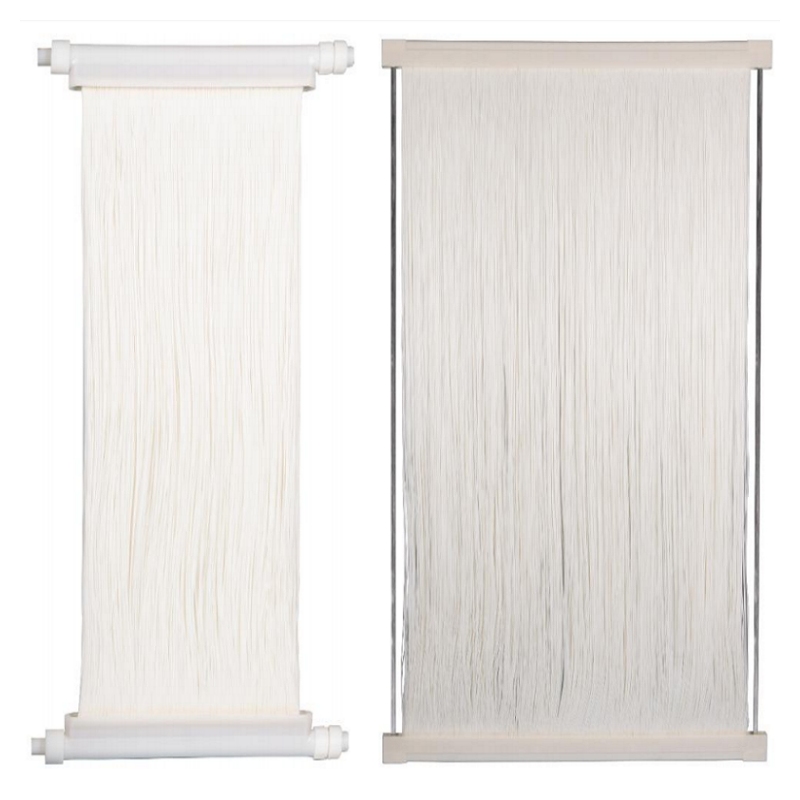
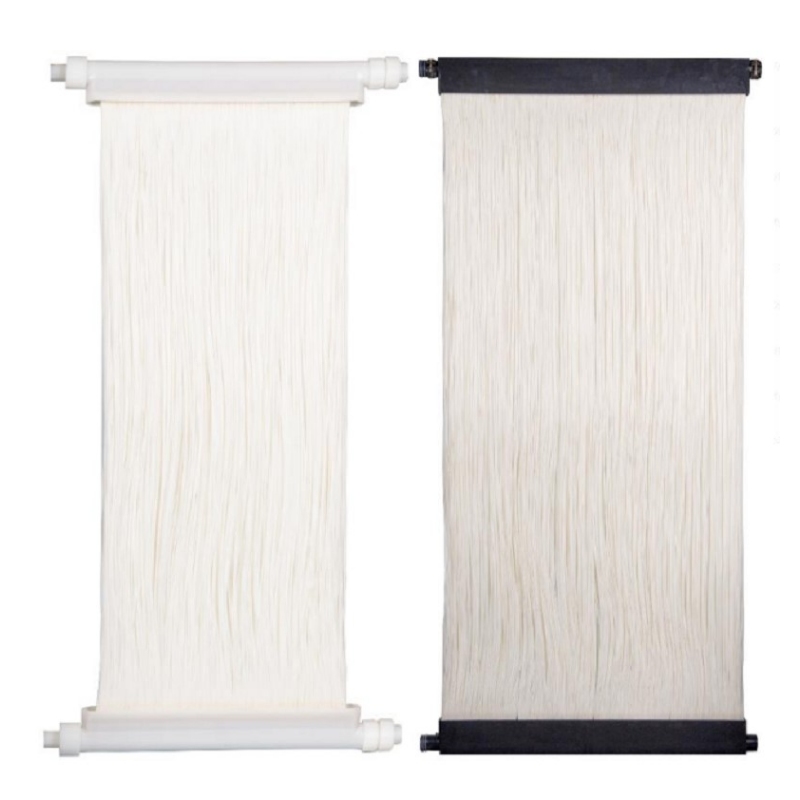
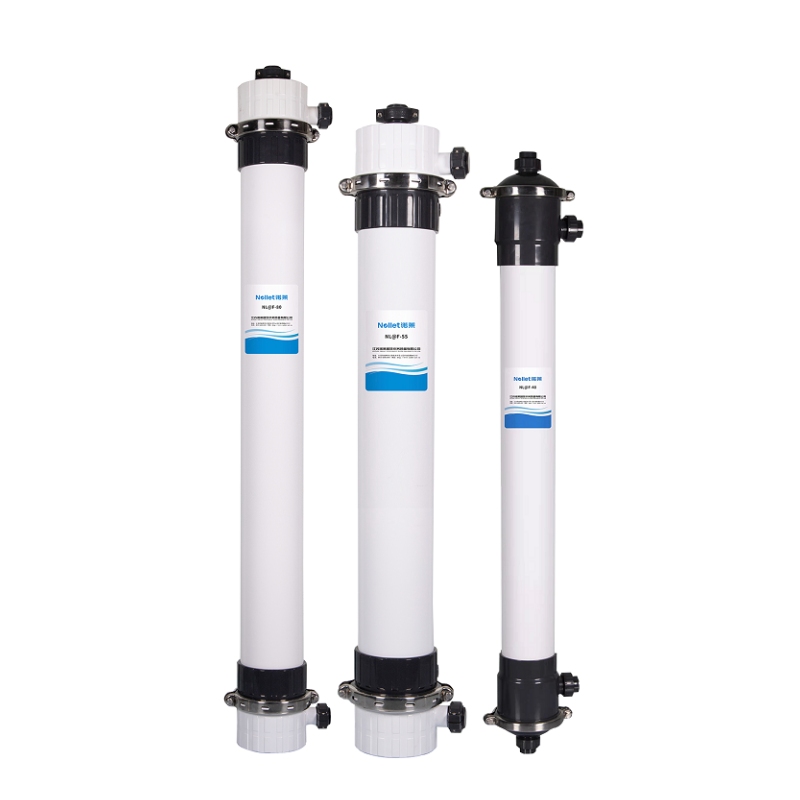
Within the combined MBR-ultrafiltration process, ultrafiltration membranes serve as the final quality control barrier that determines the final standard of reclaimed water. Boasting exceptional filtration precision and reliable operational performance, they have become a pivotal precision purification technology for wastewater reuse applications.
Five Core Characteristics of Ultrafiltration Membranes
| Characteristic | Detailed Explanation |
| Ultra-small pore size | Pores measure only 0.01–0.1 micrometres, roughly one-thousandth the diameter of a human hair, capable of intercepting nearly all harmful particles in water. To put this in perspective: if a single water droplet were scaled up to the size of a football pitch, an ultrafiltration membrane pore would be no larger than a table tennis ball on the field. |
| Pure physical filtration | No chemical additives required, zero secondary pollution or by-products generated; the original physical and chemical properties of water remain unchanged, making the process safe and eco-friendly. |
| Strong anti-fouling performance | Membrane surfaces undergo hydrophilic modification to minimise particle adhesion. Paired with upstream MBR pre-treatment, membrane fouling risk is drastically reduced, and full performance is easily restored after cleaning. |
| Fully automatic operation | The system runs 24/7 with scheduled backwashing, which flushes trapped contaminants off the membrane surface to sustain consistent filtration efficiency. |
| Long service life | Standard design lifespan ranges from 7 to 10 years, with simple maintenance and low overall operational costs. |
Core Functions of Ultrafiltration Membranes in Wastewater Reuse
Leveraging ultra-fine filtration precision, ultrafiltration membranes comprehensively improve water quality by removing all types of harmful contaminants. They guarantee reclaimed water quality across visual appearance, sanitation and chemical indicators. Specific functions and outcomes are outlined below:
| Function | Performance Metric | Practical Application |
| Bacteria interception | Near 100% bacteria removal rate | Eliminates trace residual bacteria in MBR effluent to guarantee hygienic safety of reused water |
| Virus removal | Over 99.99% virus removal rate | Eliminates biological safety hazards in water, meeting standards for high-grade reuse |
| Turbidity reduction | Effluent turbidity below 0.1 NTU | Produces crystal-clear water with superior visual quality compared to regular tap water |
| Macromolecular organic matter removal | Intercepts all pollutants with molecular weight above 1,000 Daltons | Further lowers water COD and stabilises final effluent quality |
| Protection for advanced treatment systems | Blocks fine particles to prevent fouling | Acts as a pre-filter barrier for reverse osmosis systems, ensuring stable operation of the full water reuse facility |
Standardised Wastewater Reuse Process Flow: One-Stop Production of High-Quality Reclaimed Water
The integrated MBR-ultrafiltration system follows a fixed, scientifically designed standardised workflow that progressively elevates water quality. It is currently the mainstream technology for resource recovery from municipal and industrial wastewater, featuring a clear sequence and outstanding operational stability:
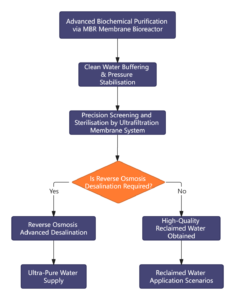
Water treated by this combined process consistently meets key quality benchmarks: turbidity < 0.1 NTU, zero detectable bacteria, COD < 20 mg/L. The output water is widely applied in urban green irrigation, road watering, landscape water replenishment, industrial cooling water, municipal toilet flushing and other scenarios.
Water Quality Data Comparison: Tracking the Entire Wastewater Transformation Process
To intuitively demonstrate the purification performance of the MBR-ultrafiltration process, we take a municipal wastewater treatment plant with a daily processing capacity of 100,000 tonnes as a case study. Measured water quality data from each treatment stage are compared below to illustrate the complete transition from turbid raw wastewater to premium reclaimed water:
| Water Quality Indicator | After Primary Treatment | After Secondary Treatment | After MBR Advanced Treatment | After MBR + Ultrafiltration Polishing |
| Turbidity (NTU) | 50–100 | 5–20 | < 0.5 | < 0.1 |
| Total Bacteria Count (CFU/mL) | 10⁶–10⁷ | 10³–10⁴ | ≤ 10 | Not Detected |
| COD (mg/L) | 200–400 | 30–60 | < 30 | < 20 |
| Water Appearance | Turbid, malodorous, high solid content | Moderately clear, slight odour, minor suspended solids | Crystal clear, odour-free, no suspended solids | Fully transparent, odourless, uniform and stable quality |
| Eligible Applications | Pre-treatment only; not reusable | Low-standard industrial discharge only; no reuse value | Basic reuse: green irrigation, toilet flushing | Full-spectrum high-grade reuse for municipal and industrial purposes |
With the mature MBR-ultrafiltration integrated process, this treatment plant produces over 30 million tonnes of high-quality reclaimed water annually. The system unlocks underutilised water resources and significantly eases urban water supply strain.
Wastewater Resource Recovery: A New Solution for Urban Water Conservation
Conventional wastewater treatment only aims to discharge treated water into natural water bodies to address pollution alone. In contrast, modern wastewater treatment utilises advanced membrane technologies including MBR and ultrafiltration to shift its core mission from “pollution remediation” to “water production”, establishing a closed-loop urban water recycling system.
Compared with alternative water supply sources such as tap water, inter-basin water transfer and seawater desalination, reclaimed water delivers core advantages of low cost, reliable supply and minimal environmental impact, making it the optimal solution for urban water conservation:
| Water Resource Type | Cost (USD per tonne) | Supply Stability | Environmental Impact |
| Tap Water | 0.3–0.6 | Dependent on rainfall; large seasonal fluctuations | Consumes natural surface water and groundwater reserves |
| Inter-Basin Water Transfer | 0.4–1.2 | Relatively stable supply | Significant disruption to river basin ecosystems |
| Опреснение морской воды | 0.6–0.9 | Fully stable, climate-independent | Risk of brine discharge pollution |
| Reclaimed Water | 0.15–0.3 | Year-round stable supply, unaffected by seasons | Minimal ecological footprint; enables circular resource utilisation |
Today, wastewater resource recovery has become a core strategy for cities to conserve, protect and preserve water resources. Supported by the advanced MBR-ultrafiltration purification process, every drop of discarded wastewater is recycled and converted into a valuable resource. The technology simultaneously resolves water pollution and supplements urban water supplies, delivering sustainable momentum for the long-term balanced development of urban water resources.