
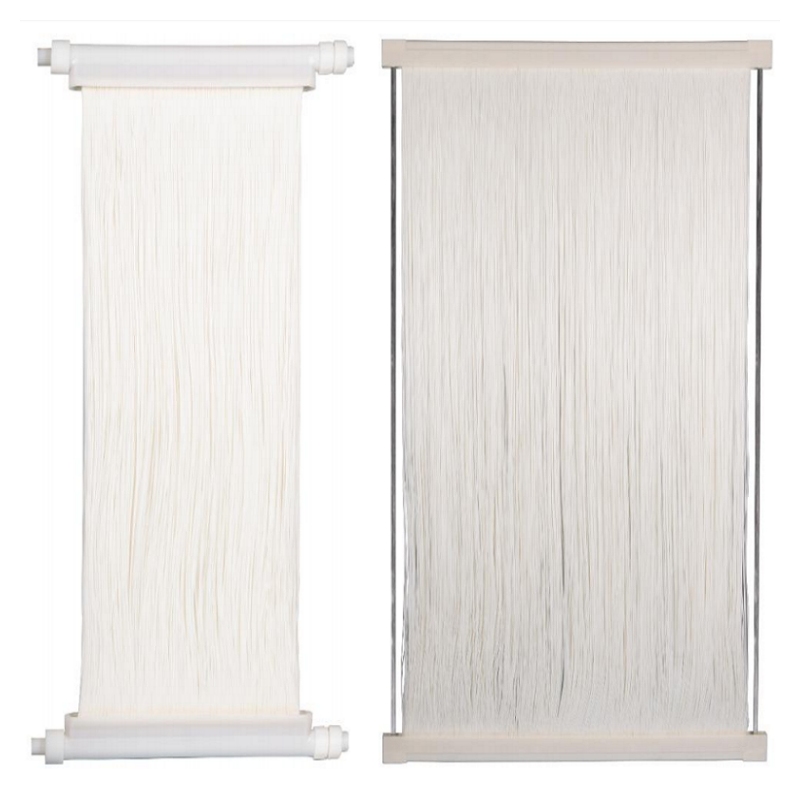
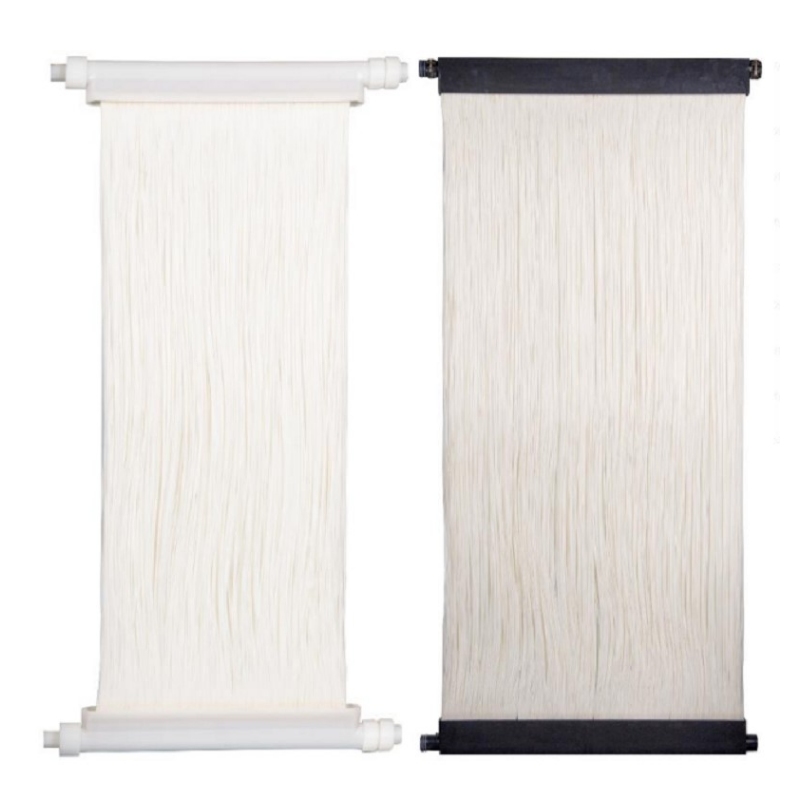
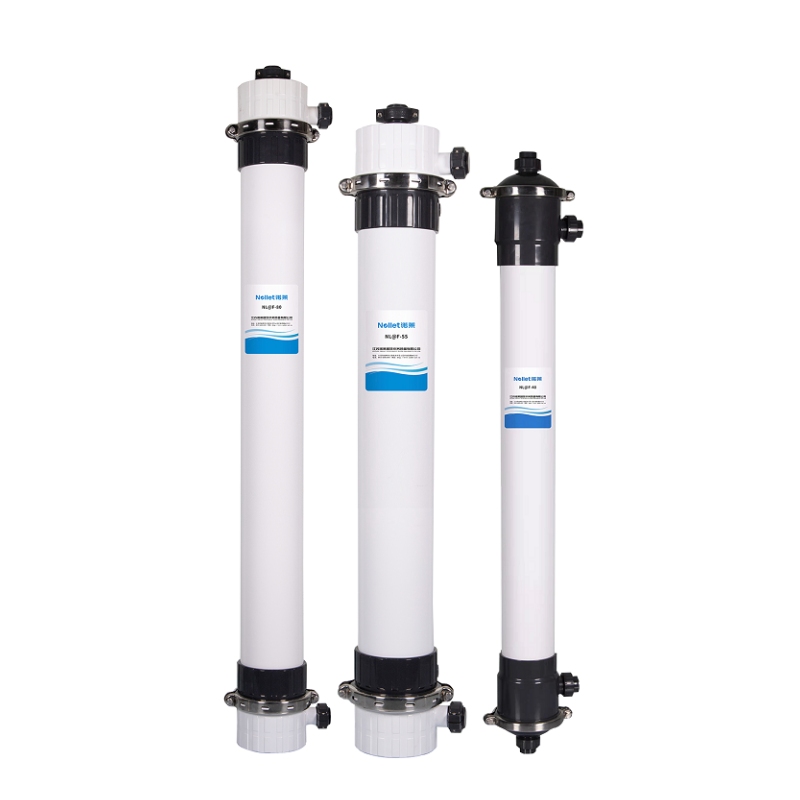
Two modules can carry the same membrane material, the same nominal pore size and the same price per square metre – and perform completely differently on the same water. The difference is where the solids go.
- Outside-in modules collect solids on the outside of the fibre, where backwash can reach them; inside-out modules collect them in the lumen.
- For high or variable solids, outside-in is generally the more forgiving choice; for very clean feed, inside-out offers higher packing density.
- Match the choice to the worst feed condition you expect each year, not the design average.
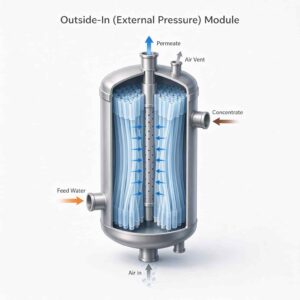
Two Geometries, One Membrane Material
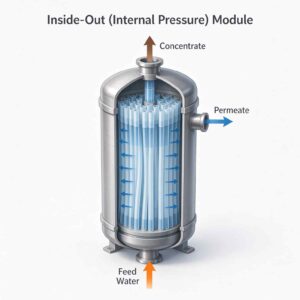
In an outside-in (pressurised) module, feed water surrounds the fibres and permeate is drawn from the inside of each fibre to a central collection tube. Solids are captured on the outer surface. In an inside-out module, feed is pushed through the lumen of each fibre and permeate exits through the wall to the shell side. Solids are captured on the inner surface.
Both work. The question is which one keeps working on the water you actually have.
Where Solids Are Captured Decides How Well They Leave
Solids on the outer surface of a fibre can be lifted by air scouring. Air bubbles rising through the module create shear at the fibre surface and scrub the cake layer loose, and the resulting debris is carried away by the concurrent water backwash. This is the single most important advantage of outside-in construction: you can use air as a cleaning mechanism.
In an inside-out module, air cannot be used the same way — you would be pushing air against the flow path inside a narrow lumen. Cleaning relies on water velocity and chemical action. That is adequate for clean feed and much less so for a compressible cake layer.
The second consequence is what happens when something goes wrong. A fibre that breaks in an outside-in module leaks feed into permeate at a limited, detectable rate, and the module can usually be isolated while the rest of the train stays in service. A lumen blocked in an inside-out module is not recoverable at all.
A Comparison of the Criteria That Decide Projects
| Criterion | Outside-In | Inside-Out |
| Solids capture location | Outer fibre surface — accessible | Inside the lumen — confined |
| Air-assisted backwash | Effective and routinely used | Not practical |
| Tolerance to feed solids | Higher; handles shock loads | Lower; needs stable, cleaner feed |
| Packing density | Lower per module volume | Higher |
| Plugging risk | Low; fouling is surface-level | Higher; irreversible if lumen blocks |
| Typical fit | Seawater and surface-water pretreatment, industrial wastewater, retrofit of existing basins | Clean well water, polishing duties, tight-footprint applications |
How to Make the Choice in Practice
Start from the worst week, not the average year. If the feed has a monsoon season, an algal bloom period or an upstream discharge event, the module has to survive that week. Ask yourself what the feed looks like on the day the plant is least able to shut down.
Then look at the cleaning strategy you can actually operate. Outside-in with air scour is more forgiving of an imperfect cleaning regime — which matters in plants where the operator is managing three systems at once. Inside-out demands more discipline: if a cleaning step is missed, the penalty accumulates.
Finally, check the retrofit context. Where a submerged configuration is being installed into an existing basin, or where the available footprint is fixed, packing density may outweigh tolerance — but in that case the upstream screening and pre-treatment must be genuinely reliable.
Three Specification Points Worth Insisting On
- Backwash test data, not just backwash claims. Ask for permeability recovery data after a defined fouling and cleaning cycle, with the test conditions stated.
- Fibre mechanical properties with a test method. Air scouring is a mechanical process; fibres that are not up to it fail early and fail invisibly.
- A stated feed envelope. Maximum turbidity, maximum TSS and the corresponding design flux. If a supplier will not state a limit, that is the answer.
Next Step
Tell us your feed source and its worst-case turbidity range, and we will indicate which configuration fits and at what design flux.
— Nollet