
Introductie
Nanofiltration (NF) membranes are a pressure-driven separation technology between reverse osmosis (RO) en ultrafiltration (UF), providing selective contaminant removal with lower energy consumption. For water treatment engineers and procurement teams, choosing the right nanofiltration membrane depends on balancing treatment performance, operating costs, and application requirements.
This article compares nanofiltration membranes with RO and UF, explaining their differences in filtration mechanisms, rejection performance, applications, selection criteria, and compliance requirements for industrial and municipal water treatment.
1. Understanding the Membrane Spectrum: NF vs. RO vs. UF
1.1 Filtration Mechanisms and Molecular Weight Cutoff (MWCO)
Membrane separation technologies are primarily defined by pore size and rejection mechanisms. Ultrafiltration (UF) membranes typically operate at 0.01–0.1 µm, removing suspended solids, colloids, bacteria, and large organic molecules through size exclusion. Reverse osmosis (RO) membranes operate at the sub-nanometer level (<0.001 µm), rejecting most dissolved salts through solution-diffusion transport but requiring higher pressure to overcome osmotic pressure.
A nanofiltratiemembraan operates between UF and RO, with pore sizes typically ranging from 0.001–0.01 µm and a molecular weight cutoff (MWCO) of approximately 200–1,000 Daltons. This selective filtration allows NF membranes to remove divalent ions such as Ca²⁺, Mg²⁺, and SO₄²⁻, as well as organic compounds and micropollutants, while allowing some monovalent ions such as Na⁺ and Cl⁻ to pass through.
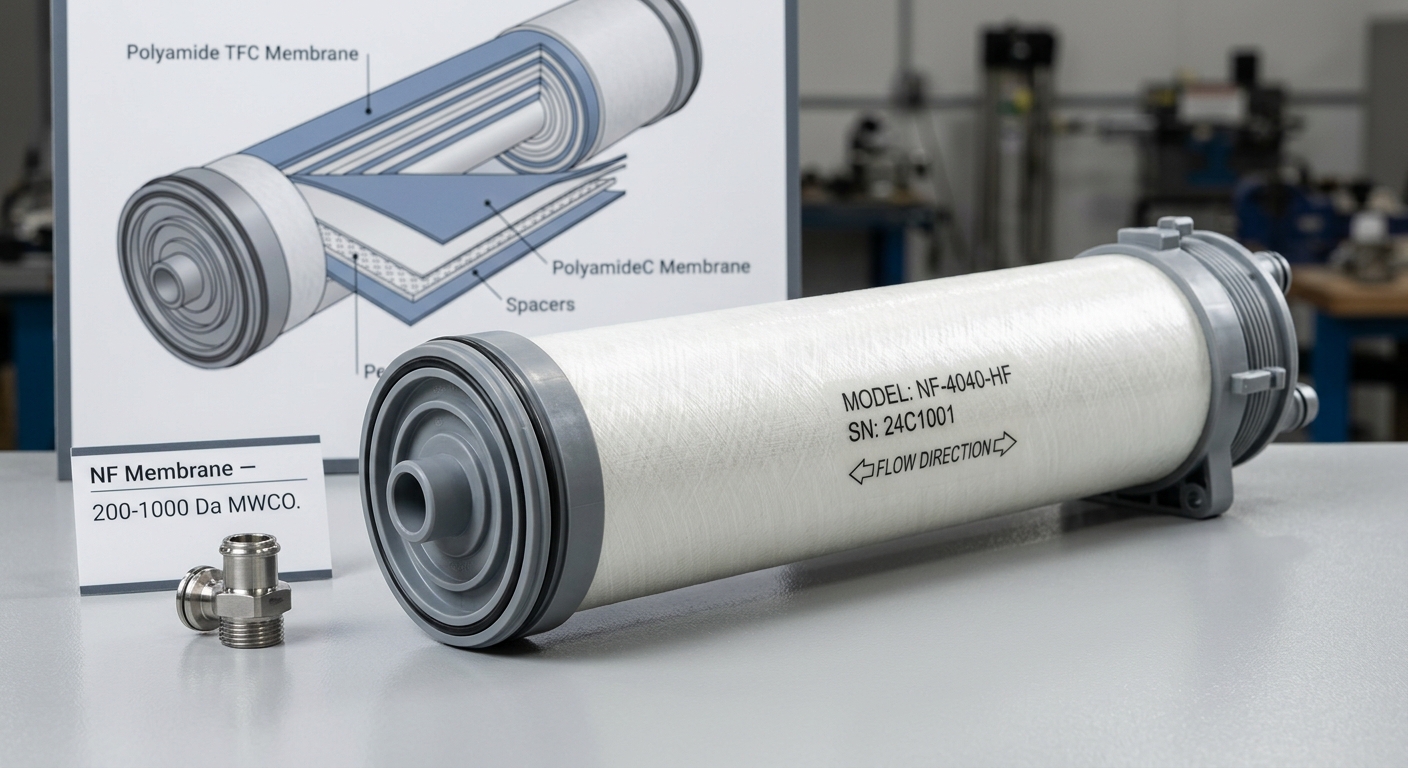
Unlike UF, nanofiltration membrane rejection is not based only on pore size. The negatively charged polyamide thin-film composite (TFC) layer enables electrostatic rejection (Donnan exclusion) of multivalent ions, providing selective separation performance between UF and RO with lower energy requirements.
1.2 Rejection Rates and Permeability Trade-offs
Nanofiltratie membranen typically operate at lower feed pressures (3–20 bar) compared with RO systems (10–70 bar), resulting in reduced energy consumption for suitable applications. This lower-pressure operation also allows higher permeate flux and improved efficiency when treating moderate-TDS water sources.
The rejection performance of each membrane technology depends on target contaminants. NF membranes generally achieve 85–98% rejection of divalent ions, such as hardness-causing minerals and sulfates, while allowing partial passage of monovalent ions. In comparison, RO provides over 95% rejection of most dissolved ions, whereas UF offers minimal ion removal capability.
| Parameter | UF | NF | RO |
|---|---|---|---|
| Pore Size (µm) | 0.01–0.1 | 0.001–0.01 | < 0.001 |
| Operating Pressure (bar) | 0.5–5 | 3–20 | 10–70 |
| MWCO (Da) | 1,000–300,000 | 200–1,000 | < 200 |
| Monovalent Ion Rejection | < 5% | 10–50% | > 95% |
| Divalent Ion Rejection | < 5% | 85–98% | > 97% |
| Typical Recovery Rate | 85–95% | 75–90% | 50–85% |
| Relative Energy Consumption | Laag | Medium | Hoog |
2. When to Choose Nanofiltration Over RO or UF
2.1 Technical Conditions That Favor Nanofiltration Membrane Selection
Nanofiltration membrane selection is technically justified when a treatment system does not require complete desalination but needs effective removal of divalent ions, natural organic matter (NOM), color compounds, or low-molecular-weight organic contaminants.
The optimal feed water TDS range for nanofiltration membranes is typically 500–2,000 mg/L. Within this range, RO may remove more dissolved minerals than necessary while consuming additional energy, whereas UF cannot effectively address dissolved hardness, sulfates, or organic micropollutants. NF provides a selective separation profile that fits this treatment window.
Key conditions that favor NF membrane selection include:
- Water softening: Feed water hardness above 150 mg/L as CaCO₃ where full desalination is unnecessary
- Color and NOM removal: Surface water or groundwater containing elevated humic substances (UV₂₅₄ > 0.1 cm⁻¹)
- Sulfate reduction: Industrial process water where SO₄²⁻ contributes to scaling or affects production performance
- Micropollutant removal: Pesticides, endocrine-disrupting compounds, and pharmaceutical residues within the 200–1,000 Da range
- Mineral retention: Drinking water applications where complete demineralization may affect taste, stability, or corrosion control
When partial salt passage is acceptable or beneficial — such as boiler feed water pre-treatment or certain food processing applications — a nanofiltratiemembraan can achieve target contaminant removal without the higher energy demand associated with RO.
2.2 Economic and Operational Advantages of Nanofiltration Membranes
From a total cost of ownership (TCO) perspective, nanofiltration membranes can provide significant advantages over both RO and UF when applied to suitable feed water conditions.
Compared with RO: Lower operating pressure reduces pump energy requirements, pressure vessel demands, and overall system costs. For example, in a 1,000 m³/day brackish groundwater treatment system at 1,200 mg/L TDS, replacing RO with NF can reduce energy consumption by approximately 35–50% while maintaining effective hardness and organic contaminant removal. Lower operating stress may also extend membrane service life, with typical replacement cycles ranging from 3–7 years depending on feed chemistry and cleaning conditions.
Compared with UF: NF membranes provide removal of dissolved contaminants, divalent ions, and organic compounds that UF cannot effectively reject. This can reduce the need for additional treatment stages such as chemical softening, activated carbon polishing, or advanced disinfection, lowering chemical usage and system complexity.
The economic advantage of nanofiltration membrane technology is strongest when feed water characteristics match its selective separation capability — particularly moderate TDS levels, hardness-dominated mineral content, and organic contaminants within the NF molecular weight range.
3. Key Application Scenarios for Nanofiltration Membranes
3.1 Industrial and Municipal Water Treatment
Nanofiltratie membranen are widely used in industrial and municipal water treatment applications where selective contaminant removal, lower energy consumption, and mineral retention are important considerations.
- Drinking Water Production
NF is commonly applied for surface water treatment where NOM removal, color reduction, and disinfection byproduct (DBP) precursor control are key objectives. Compared with conventional treatment processes, NF can reduce chemical dosing requirements and simplify treatment configurations in suitable municipal systems.
- Water Softening
Nanofiltration membrane systems can replace traditional lime softening or ion exchange processes in applications such as cooling tower makeup water, boiler feed pre-treatment, and beverage production. NF achieves high hardness removal while avoiding chemical regeneration waste streams.
- Food and Beverage Processing
In dairy processing, NF is used for whey concentration and lactose separation. Beverage manufacturers apply NF for water standardization, maintaining consistent mineral profiles without complete demineralization. Sugar processing facilities also use NF for color compound removal.
- Textile and Industrial Effluent Treatment
NF membranes effectively remove reactive dyes, sulfates, and metal-organic complexes from textile wastewater, supporting water reuse and helping industries meet discharge requirements.
- Wastewater Reclamation
NF serves as a polishing step in water reuse systems, reducing trace organic compounds and residual hardness after biological treatment.
3.2 Pharmaceutical and Chemical Process Applications
In pharmaceutical manufacturing and fine chemical production, nanofiltration membrane technology enables selective molecular separation while improving process efficiency and product quality.
- API Concentration and Purification
NF membranes can retain active pharmaceutical ingredients (APIs) in the 300–1,000 Da range while allowing smaller impurities and reaction by-products to pass through. This enables concentration processes without excessive thermal exposure.
- Solvent Recovery
Organic-solvent-resistant NF membranes, including polyimide-based and silicon-based materials, can recover valuable solvents from pharmaceutical synthesis streams, reducing solvent consumption and supporting environmental compliance objectives.
- Selective Ion Separation
Chemical manufacturers use NF membranes for separating divalent metal ions, recovering catalysts, removing scaling compounds, and concentrating valuable process streams with continuous operation advantages over conventional ion exchange methods.
- GMP and FDA Alignment
For pharmaceutical applications, NF systems should meet relevant regulatory requirements, including data integrity controls, material compatibility testing, extractables and leachables (E&L) evaluation, and clean-in-place (CIP) or sanitization-in-place (SIP) capabilities.
4. NF Membrane Selection Criteria and Compliance Standards
4.1 Critical Specification Parameters for Procurement
Selecting the right nanofiltratiemembraan requires evaluating membrane materials, module configuration, and operating conditions based on feed water characteristics and process requirements.
Membrane material: Polyamide thin-film composite (TFC) is the most widely used material for commercial NF membranes, offering high flux, strong divalent ion rejection, and a broad pH operating range (3–10). Cellulose acetate (CA) membranes provide better chlorine resistance but generally have a narrower pH tolerance and lower flux. Ceramic NF membranes, including alumina and titania types, are selected for demanding applications involving high temperatures, extreme pH conditions, or solvent-containing streams where polymeric membranes may not perform effectively.
Module configuration: Spiral wound modules are commonly used in industrial and municipal water treatment due to their high packing density and cost efficiency. Tubular modules are preferred for high-fouling applications, such as industrial wastewater and food processing, where easier cleaning and fouling control are more important than compact design.
Key operating parameters to evaluate when selecting an NF membrane include:
- Maximum operating pressure and temperature
- Chlorine tolerance and exposure limits
- Continuous and CIP pH operating range
- Feed water SDI (Silt Density Index) requirements
- Flux decline and recovery performance after CIP cleaning
4.2 Relevant Industry Standards and Certifications
Before finalizing nanofiltratiemembraan procurement, buyers should verify applicable certifications to ensure material safety, regulatory compliance, and long-term system reliability.
NSF/ANSI 58: Applicable to NF membranes used in drinking water systems in North American markets, verifying contaminant reduction performance and material safety.
ISO 9001: Demonstrates the membrane manufacturer’s quality management system and serves as a basic qualification requirement for industrial suppliers.
REACH Compliance: Required for products supplied to European markets, confirming that membrane materials and manufacturing chemicals comply with EU chemical safety regulations.
CE Marking: Required for applicable pressure-rated membrane systems and equipment sold within the European Economic Area.
FDA 21 CFR: Relevant for membranes used in food, beverage, and pharmaceutical applications, ensuring material compatibility and extractables compliance.
Veelgestelde vragen
1. What feed water TDS range is nanofiltration membrane most cost-effective for, compared to reverse osmosis?
NF membranes deliver the strongest TCO advantage in the 500–2,000 mg/L TDS range. Below 500 mg/L, UF or simple carbon filtration may suffice. Above 2,000 mg/L, osmotic pressure increases to the point where RO’s higher-pressure design becomes necessary to achieve adequate recovery rates. Within the 500–2,000 mg/L window, NF operates at 30–60% lower energy than equivalent RO systems while meeting most industrial and municipal treatment objectives.
2. Can nanofiltration membranes replace RO in drinking water systems without compromising regulatory compliance?
In many jurisdictions, yes — provided the feed water TDS and contaminant profile align with NF’s rejection capabilities. NF systems certified under NSF/ANSI 58 can support compliance with drinking water requirements where applicable. However, NF does not achieve the monovalent ion rejection required for seawater desalination or high-TDS brackish water treatment. Regulatory pre-approval from the relevant authority is required before substituting NF for RO in permitted municipal systems.
3. What are the primary fouling risks for NF membranes in industrial wastewater applications, and how are they mitigated?
The dominant fouling mechanisms in NF are scaling (calcium carbonate, calcium sulfate, silica), organic fouling (humic acids, proteins, surfactants), and biofouling. Mitigation strategies include antiscalant dosing ahead of the NF stage, pH adjustment to reduce scaling potential, regular CIP cycles with acidic and alkaline cleaning agents, and UV or biocide pre-treatment for biofouling control. Feed water SDI should be maintained below 5 through pre-filtration (multimedia or UF) to protect NF membrane surfaces from colloidal fouling.
Conclusie
Nanofiltration membranes provide an effective solution when water treatment requires selective ion removal, moderate desalination, and lower energy consumption. By balancing feed water conditions, contaminant targets, and operating requirements, system designers can select the right NF technology instead of over-specifying RO or under-performing UF systems.
Proper membrane material selection, module configuration, and compliance verification help ensure long-term performance and reliability. If you need support choosing the right nanofiltration membrane for your application, contact Nollet for compatibility assessment and customized membrane solutions.