
Abstract
For industrial water treatment and process filtration operators, persistent fouling, escalating CIP frequency, and inconsistent flux are not isolated problems—they are systemic signals of a membrane configuration that no longer matches your process demands. Many plants continue running underperforming systems, absorbing the costs through increased chemical spend, unplanned downtime, and premature module replacement—without identifying the root cause.
This article defines five concrete operational warning signs that indicate your current membrane setup is failing you, and explains why inside-out membrane modules represent a structurally superior alternative. Whether you are a procurement engineer benchmarking membrane filtration module options or a plant manager evaluating a system overhaul, this guide covers the technical principles, performance benchmarks, compliance considerations, and total cost of ownership factors that matter most. Understanding these signals early translates directly into lower lifecycle costs, higher system reliability, and better compliance outcomes across municipal, industrial, food & beverage, and pharmaceutical applications.
Understanding the Inside-Out Flow Principle
How Inside-Out Configuration Differs from Outside-In
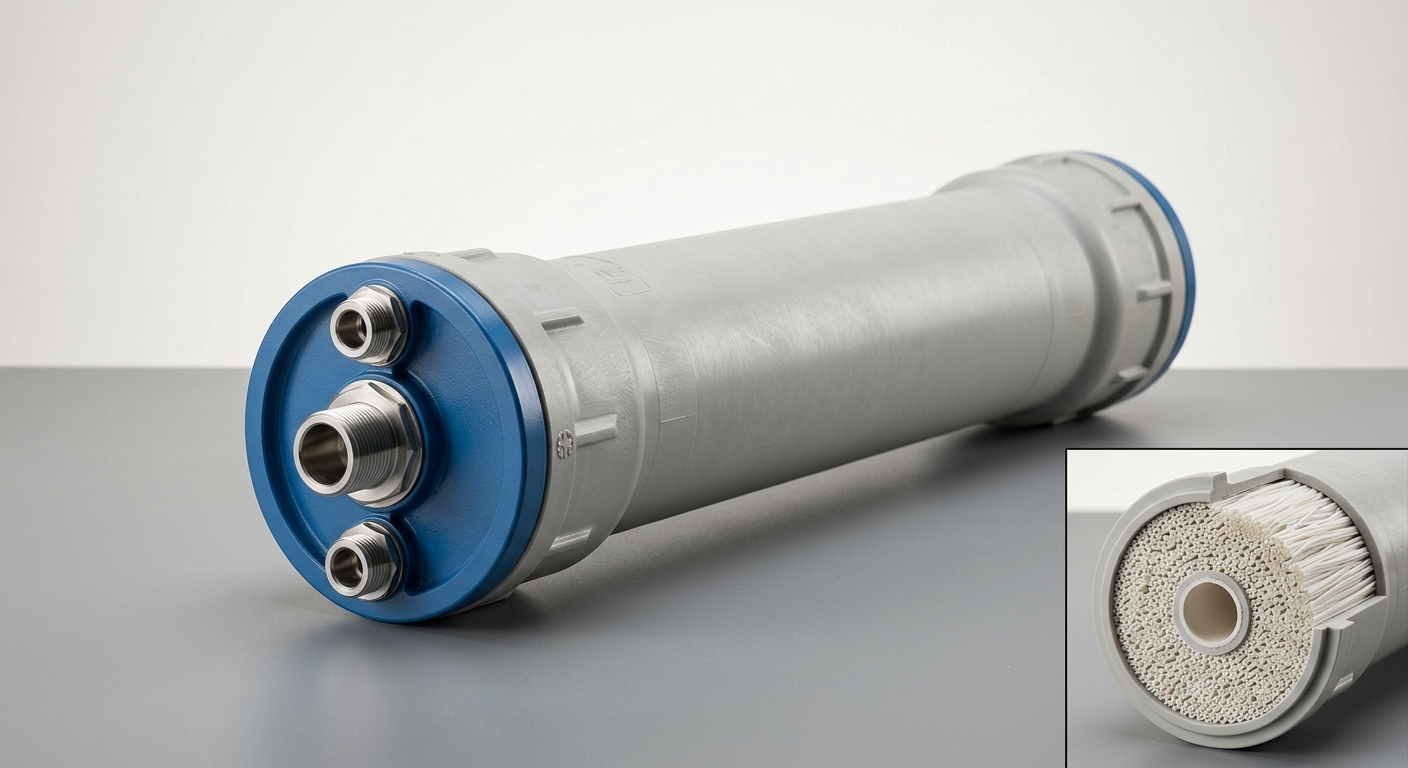
In a hollow fiber membrane module, flow direction is the single most consequential design variable. In an outside-in configuration, feed water enters from the shell side, permeating inward through the fiber wall toward the lumen. In an inside-out configuration, feed water is introduced directly into the fiber lumen, flows along the inner surface under positive pressure, and permeate exits through the fiber wall to the shell side.
This seemingly simple inversion has significant mechanical consequences. Lumen-side feeding concentrates hydraulic shear force precisely at the membrane surface where fouling initiates. The controlled, uniform flow path across each fiber’s inner wall maintains consistent cross-flow velocity, reducing the stagnant boundary layer that accelerates particle deposition. Because each fiber operates as an independent flow channel with defined inlet pressure, flow distribution across the module is inherently more uniform than in shell-side feed designs, where channeling between fiber bundles is a persistent engineering challenge.
Why Flow Direction Determines Fouling Behavior
Fouling behavior is directly governed by where and how particles accumulate relative to the membrane surface. In outside-in modules, particles suspended in the feed stream can accumulate within the interstitial spaces between fibers on the shell side—zones that are geometrically difficult to clean and hydraulically inaccessible during backwash cycles.
Inside-out modules invert this dynamic. Particle accumulation occurs on the inner lumen surface, which is fully exposed to backwash flow in reverse direction. This geometric accessibility makes fouling largely reversible through hydraulic means alone, reducing dependence on chemical cleaning. Furthermore, the fiber wall experiences compressive stress from lumen-side pressure rather than tensile stress from shell-side pressure, which contributes to longer fiber integrity life under sustained operating conditions.
The 5 Operational Signs You Need to Switch
Signs 1–3 — Fouling, CIP Frequency, and Uneven Flux
Sign 1 — Fouling Rate Exceeds Recoverable Thresholds. A well-performing membrane system should recover ≥95% of initial flux after a standard backwash cycle. If your transmembrane pressure (TMP) rises more than 15–20% within a single filtration cycle before recovery, or if post-backwash flux recovery drops below 85% consistently, you are experiencing irreversible fouling accumulation. This is a structural signal, not a water quality anomaly.
Sign 2 — CIP Cycles Are Increasing in Frequency. Industry benchmarks for well-matched membrane systems in secondary effluent or surface water applications typically range from one CIP every 30–90 days. If your operation has escalated to weekly or bi-weekly CIP cycles, the chemical and labor costs are compounding—but more critically, each aggressive cleaning cycle accelerates membrane degradation. Inside-out modules, by limiting irreversible fouling through superior backwash geometry, extend CIP intervals by 40–60% in comparable feed water conditions.
Sign 3 — Flux Deviation Across the Module Array Exceeds ±10–15%. Uneven flux distribution is a leading indicator of fiber channeling, partial blockage, or uneven fiber packing density. In outside-in modules, shell-side flow distribution is inherently less controllable, and preferential flow paths develop over time. Inside-out modules enforce individual fiber-level flow control through lumen-side feeding, reducing inter-fiber flux variance and improving overall array performance consistency.
Signs 4–5 — Shortened Module Lifespan and Rising Operating Costs
Sign 4 — Module Service Life Falls Below 3–5 Years. Hollow fiber membranes in well-managed systems should achieve 5–7+ years of operational life. Premature integrity failures—detected through pressure decay tests or bubble point testing—indicate fiber fatigue from mechanical stress, chemical attack, or sustained fouling-induced TMP spikes. Inside-out fiber geometry distributes mechanical load more evenly, and PVDF-based inside-out modules demonstrate superior chemical resistance to oxidative CIP agents (sodium hypochlorite, citric acid) compared to PES alternatives under equivalent cleaning regimes.
Sign 5 — Energy and Chemical Costs Are Trending Upward Without Capacity Increase. Rising specific energy consumption (kWh/m³ permeate) without a corresponding increase in throughput is a lagging but reliable signal of system inefficiency. Increased backwash frequency, higher pump pressure to overcome fouling resistance, and elevated chemical volumes all contribute. This cost escalation is often misattributed to feed water variability when the underlying cause is membrane configuration mismatch.
Table: Inside-Out vs. Outside-In Membrane Module — Performance Parameter Comparison
| Sistem de membrană la presiune | Inside-Out Module | Outside-In Module | Operational Impact |
|---|---|---|---|
| Fouling Rate | Low–Moderate | Instalare | Longer filtration cycles |
| CIP Frequency | Every 30–90 days | Every 7–30 days | Reduced chemical consumption |
| Flux Uniformity | ±5–8% variance | ±15–25% variance | Consistent permeate quality |
| Service Life | 5–8 years | Acest comparație arată clar de ce modulul de membrană submersibilă pregătit pentru adaptări pentru modernizarea stațiilor de apă | Lower replacement CAPEX |
| 2,5–4,0 kWh/m³ | Lower (reduced TMP) | Higher (fouling resistance) | Reduced OPEX per m³ |
| Backwash Efficiency | High (lumen-accessible) | Moderate (shell-side limited) | Higher hydraulic recovery |
Technical Specifications & Compliance Standards
Key Module Specifications for Procurement Evaluation
When evaluating inside-out membrane filtration modules, the following specification parameters are critical for procurement comparison:
- Nominal Pore Size: 0.01–0.1 µm (ultrafiltration range); MF variants available at 0.1–0.4 µm
- MWCO Range: 10,000–150,000 Daltons depending on application
- Fiber Materials: PVDF (preferred for chemical resistance and mechanical durability), PES (higher flux at lower pressure), PP (lower cost, limited chemical compatibility)
- Operating Pressure: Typically 0.5–3.0 bar TMP; maximum housing pressure 4–6 bar
- Operating Temperature: 5–45°C continuous; PVDF modules tolerate up to 60°C for hot CIP protocols
- Module Dimensions: Standard configurations range from 4-inch to 8-inch diameter housings; lengths from 1,000–2,000 mm; custom skid-mounted arrays available for large-scale installations
PVDF remains the preferred fiber material for high-fouling and chemically aggressive feed streams due to its resistance to chlorine concentrations up to 200,000 ppm·h cumulative exposure—a critical factor for oxidative CIP longevity.
Relevant Industry Standards and Certifications
Compliance verification is non-negotiable for drinking water and food-contact applications:
- NSF/ANSI 61: Required for drinking water contact materials in North American municipal applications. Verify that module housing materials and potting compounds carry current certification.
- EU Drinking Water Directive (2020/2184): Governs material safety for European municipal installations; requires conformity assessment for polymer components in contact with potable water.
- ISO 8573: Relevant for compressed air and gas filtration variants of membrane modules used in pharmaceutical and food & beverage settings.
- Integrity Testing Protocols: Pressure decay testing (PDT) and bubble point testing are the standard methods for verifying membrane integrity post-installation and post-CIP. Procurement specifications should require documented PDT values (typical pass threshold: pressure decay ≤0.5 kPa/min at 80 kPa applied pressure).
Application Scenarios and Commercial Value
Target Industries and Process Fit
Inside-out membrane modules deliver differentiated value across several high-demand sectors:
- Municipal Water Reuse: Surface water and secondary effluent with TSS up to 50 mg/L; inside-out configuration handles moderate turbidity feeds (up to 100 NTU with coagulation pre-treatment) without rapid fouling escalation.
- Industrial Effluent Treatment: Cooling tower blowdown, produced water polishing, and process water recovery—applications where feed variability demands robust backwash performance.
- Food & Beverage Clarification: Beverage pre-filtration, dairy whey processing, and juice clarification benefit from the hygienic design and CIP-compatible fiber materials of inside-out PVDF modules.
- Pharmaceutical Pre-filtration: Upstream of RO or NF systems, inside-out UF modules provide consistent SDI reduction (target SDI <3) to protect downstream membranes from colloidal fouling.
ROI Drivers and Total Cost of Ownership
The commercial case for inside-out membrane modules is quantifiable across three primary cost categories:
- Chemical Reduction: Extending CIP intervals from monthly to quarterly reduces NaOCl and citric acid consumption by 50–70% annually in typical surface water applications.
- Extended Replacement Cycles: A 2-year increase in module service life (from 4 to 6 years) at an average module cost of $800–$2,500 per unit represents significant CAPEX deferral across a 20-module array.
- Downtime Cost Avoidance: Each unplanned CIP event in a 1,000 m³/day plant incurs 4–8 hours of reduced production capacity. Reducing CIP frequency by half directly reduces lost production costs.
FAQ
Q1: What feed water turbidity levels are inside-out membrane modules rated to handle before pre-treatment is required?
Inside-out UF modules are generally rated for feed turbidity up to 30–50 NTU without pre-treatment in continuous operation. For feeds exceeding 100 NTU, coagulation/flocculation or media filtration pre-treatment is recommended to prevent accelerated fouling and maintain backwash efficiency. Some high-capacity PVDF inside-out modules are designed for up to 200 NTU with enhanced backwash protocols.
Q2: How does CIP chemical compatibility vary across inside-out module fiber materials (PVDF vs. PES)?
PVDF fibers tolerate sodium hypochlorite concentrations up to 500 mg/L during CIP and cumulative chlorine exposures up to 200,000 ppm·h, making them suitable for aggressive oxidative cleaning regimes. PES fibers offer higher initial flux but are limited to lower chlorine concentrations (typically <200 mg/L) and are more susceptible to hydrolysis at elevated temperatures. For applications requiring frequent or aggressive CIP, PVDF inside-out modules provide a significantly longer operational lifespan.
Q3: What integrity testing method is recommended to verify inside-out module performance after installation?
Pressure decay testing (PDT) is the industry-standard method for post-installation verification of inside-out hollow fiber modules. The module lumen side is pressurized to 80–100 kPa with air or nitrogen, isolated, and pressure decay is measured over 5 minutes. A decay rate ≤0.5 kPa/min typically indicates acceptable integrity. Bubble point testing is used for more precise defect localization when a module fails PDT. Both methods should be documented in commissioning records and repeated after each CIP cycle as part of a routine integrity management program.
Modulul submersibil de membrană reprezintă o schimbare paradigmatică în tratarea apei, oferind rezultate superioare în scenarii care cer spațiu compact, calitate stabilă a efluentului, consum redus de energie și rezistență puternică la poluare. De la sistemele municipale MBR și reutilizarea apei industriale până la producția de apă potabilă și tratarea lichidelor de percolare din depozitele de gunoi, depășește procesele convenționale și tehnologiile cu membrane presurate în cele mai dificile aplicații.
Inside-out membrane modules address the root causes behind the five most common filtration performance failures—not just the symptoms. Persistent fouling, escalating CIP frequency, uneven flux distribution, premature module failure, and rising operating costs are each traceable to flow geometry and fiber design decisions that inside-out configuration resolves structurally.
For procurement and engineering teams benchmarking membrane filtration module upgrades, the technical advantages of lumen-side feed—superior backwash accessibility, controlled shear distribution, and consistent inter-fiber flow uniformity—translate directly into measurable outcomes: longer service life, reduced chemical consumption, lower downtime frequency, and simplified compliance management. When evaluated on a total cost of ownership basis over a 7–10 year asset horizon, inside-out membrane modules consistently outperform outside-in alternatives across the operational parameters that matter most to plant economics.
If two or more of the five signs described in this article match your current operational profile, the case for evaluating inside-out membrane modules is not speculative—it is supported by the data your own system is already generating.