


April 2026 – The World Bank, together with several multilateral development banks, has unveiled Water Forward, a global action plan to improve water security for 1 billion people by 2030.
Figure: World Bank Water Forward official release page
More striking than the target itself is the strategy behind it. Instead of funding large dams or long-distance water transfers, Water Forward focuses on urban leakage control, irrigation modernization, wastewater reuse, and data-driven planning.
This marks a quiet but fundamental shift: global water policy is moving from pure “infrastructure expansion” to water security economics-a new approach centred on efficiency, resilience, and resource management.
From Engineering Marvels to Systemic Resilience
For decades, water policy followed a “supply-gap” logic: build more dams, treatment plants, and diversions. But this heavy‑asset model now faces diminishing returns. Capital costs are high after global rate hikes, the best dam sites are already taken, and climate change brings unprecedented droughts and floods that static infrastructure cannot handle.
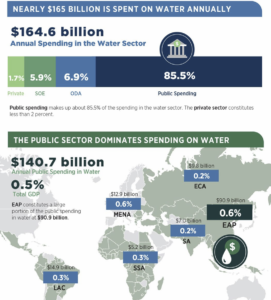
Water Forward repositions water not as an infrastructure by-product, but as a foundational economic asset – one that constrains growth and shapes development quality.
Four Priority Battlefields
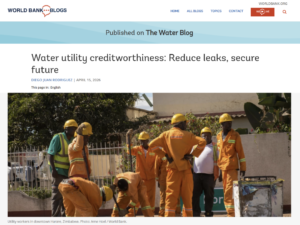
- Urban leakage control- In many cities, 30-50% of water is lost before reaching customers. Fixing leaks is often the cheapest, fastest “new source” of water. Utilities in leakage-control programmes typically have non-revenue water above 45%.
- Irrigation modernization – Agriculture uses 70% of global freshwater. Traditional flood irrigation wastes huge volumes. Precision irrigation can raise output per cubic metre- the only way to reconcile food and water security.
- Wastewater reuse -The linear “take-use-discharge” model is breaking down. Water Forward treats supply, sewage, reclamation and desalination as an integrated portfolio. In California’s Oakley, a recent ban on new data centers was imposed precisely due to water and electricity concerns. Water availability is increasingly tied to investment and land‑use approvals.
- Data‑driven planning-Satellite remote sensing, smart meters and digital twins make water “measurable, priceable and tradable”, providing the credit foundation for private finance.
Water Security Economics: Three Dimensions
Water Forward signals a shift from “big infrastructure logic” to a higher-dimensional view: water is not a peripheral utility sector, but a foundation for economic activity, competitiveness, and social resilience.
This involves three value shifts:
– Risk value-A city with resilient water systems improves its credit rating and investment appeal. Security itself becomes a financial asset.
– Factor productivity-Future competitiveness will depend not on who owns more water, but on who generates higher GDP per cubic metre and per kilowatt‑hour.
– Rebalancing public goods and markets-Market tools drive efficiency (industry, reuse), while the savings guarantee basic access for the poor-a higher form of distributive justice.
A New Role for the Water Sector
For decades, water was seen as a supporting sector for urban expansion. The future treats it as a foundational security sector for the entire economy. The former relied on construction dividends; the latter requires integrated capabilities in operations, finance, risk, and data.
Water Forward is more than a funding programme – it is a strategic roadmap. The world’s most important water infrastructure is no longer always concrete and steel; increasingly, it is better management, smarter data, and more efficient use of every drop.
Sources: World Bank, Funding a Water-Secure Future, April 2026.