
Введение
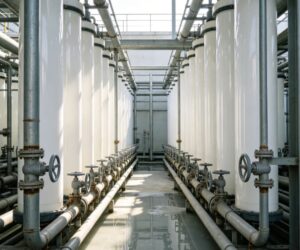
Walk onto any wastewater treatment floor, and you’ll see rows of tall cylindrical membrane modules that look nearly identical from the outside. Yet inside those white UPVC shells, two fundamentally different processes are at work: some push water through hollow fibers from the inside out, while others draw it from the outside in. This seemingly small difference significantly affects treatable water quality, cleaning frequency, and membrane lifespan.
The global hollow fiber ultrafiltration market reached $2.53 billion in 2025 and is growing at a 17.6% CAGR toward $10.88 billion by 2034. This guide cuts through the complexity with a clear, practical comparison of inside-out versus outside-in membrane modules, helping you select the configuration that best fits your wastewater and plant operations.
What Exactly Is an Inside-Out UF Membrane Module?
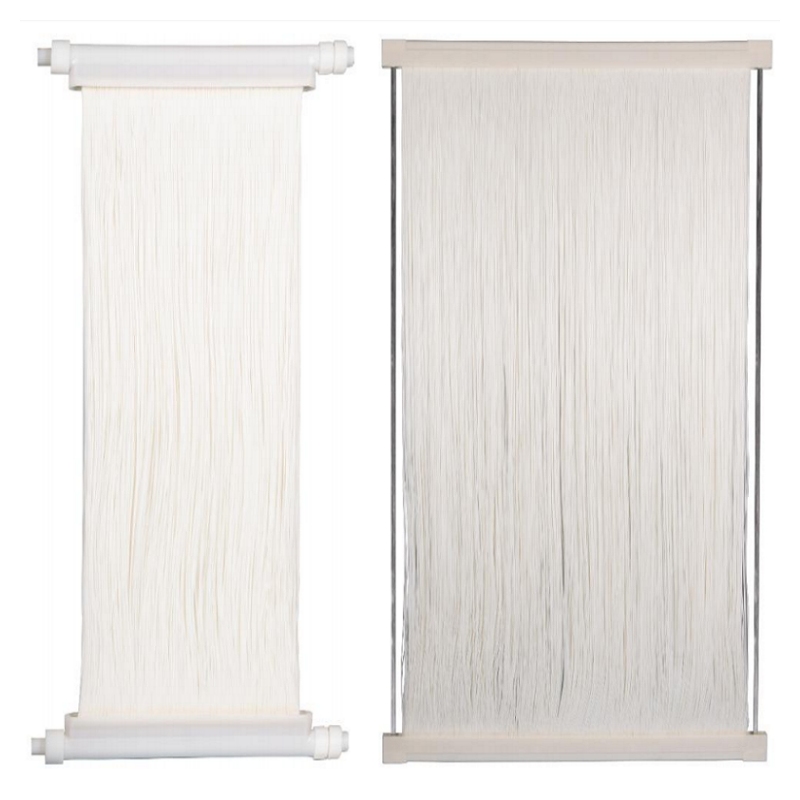
In an inside-out UF membrane module, feed water enters the hollow fiber lumens (the tiny tubes inside each fiber). The separation layer is on the inner surface, so water flows radially outward through the membrane wall, and permeate is collected on the outside.
Material and Construction
Inside-out modules typically use PES (polyethersulfone) membrane material, which offers good chemical stability and oxidation resistance. The nominal pore size is 0.01 μm, effectively removing bacteria, viruses, colloids, and macromolecular organics.
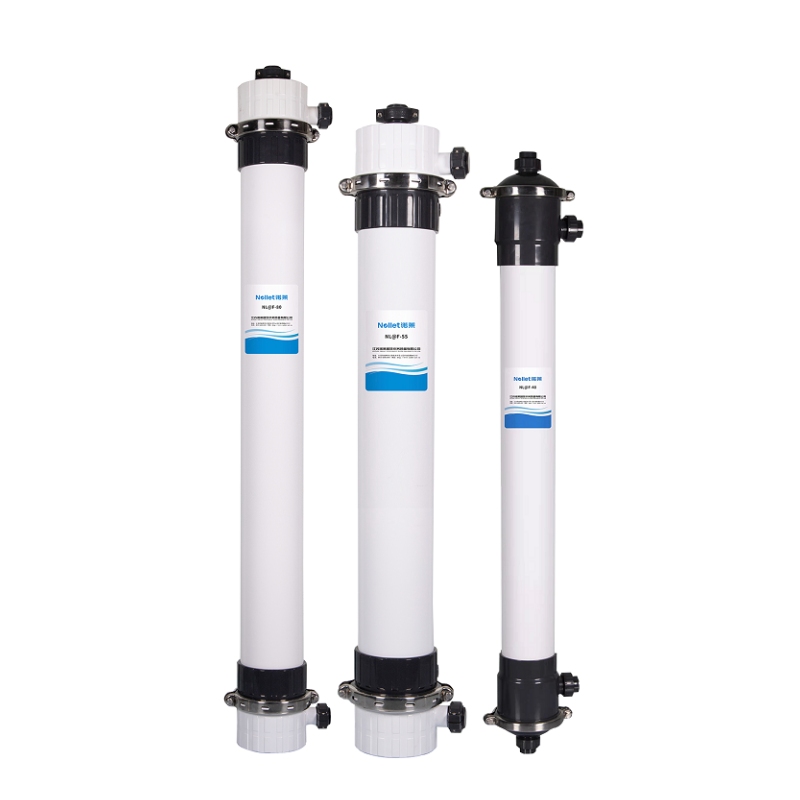
Modules come in different sizes — for example, Nollet’s NL@S-15 (15 m²) and NL@S-45 (45 m²). They feature UPVC shells, epoxy resin sealing, and support both wet and dry storage. Thanks to higher fiber packing density, they deliver more filtration area in a compact footprint.
Operating Parameters
These modules operate at 0.1–0.3 MPa with a filtration flux of 50–120 L/m²·h. They support full-flow or cross-flow modes with 20–60 minute cycles. Backwashing uses water at 0.2 MPa for about 1 minute.
Maximum influent turbidity is 20 NTU. Exceeding this limit risks rapid fouling. While the short backwash cycle reduces downtime, water-only cleaning may not fully remove stubborn solids.
Typical Applications
Inside-out UF membrane modules are ideal for relatively clean feed waters, such as:
- River, reservoir, and mountain spring water purification
- Pretreatment for seawater desalination
- Industrial wastewater with low solids content
- Sewage reuse after secondary treatment
- Cooling tower makeup water
What Is an Outside-In UF Membrane Module?
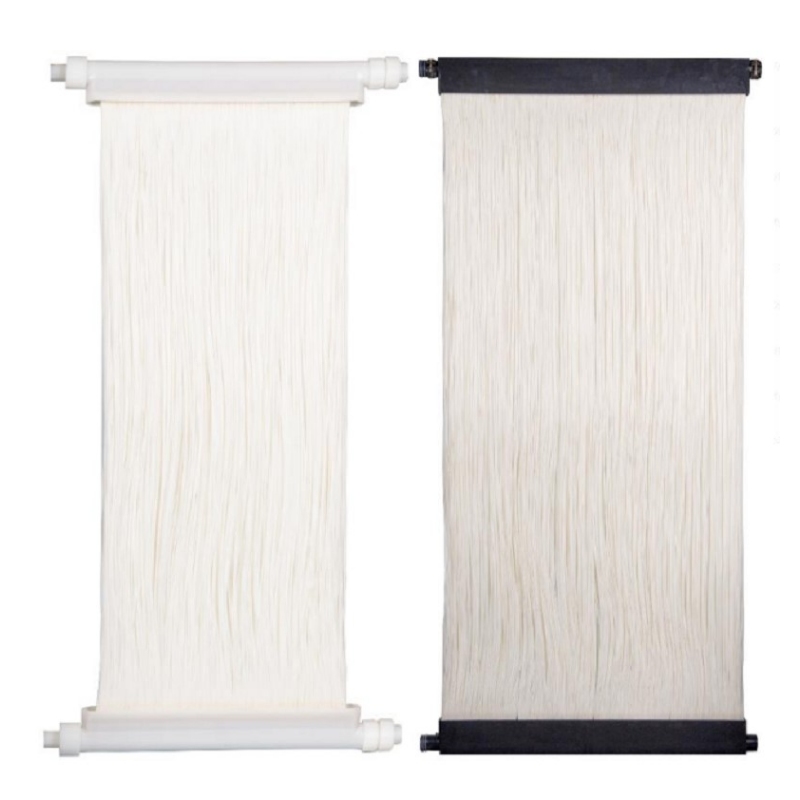
In an outside-in UF membrane module, feed water flows around the exterior of the hollow fibers. The separation layer is on the outer surface, allowing water to pass inward through the membrane wall into the fiber lumen for permeate collection.
Material and Construction
These modules use PVDF (polyvinylidene fluoride) membrane material, known for excellent chemical stability and strong fouling resistance. The nominal pore size is also 0.01 μm.
Effective membrane area is larger — e.g., Nollet’s NL@F-55 (55 m²) and NL@F-80 (80 m²). They share UPVC shells and epoxy sealing with wet/dry storage capability. While each module produces more permeate, the overall unit size is larger.
Operating Parameters
Operating pressure is the same (0.1–0.3 MPa), with a filtration flux range of 30–135 L/m²·h and 20–60 minute cycles.
The key difference is backwashing: gas-water backwashing for 2–3 minutes at ≤0.25 MPa. Air scouring effectively removes solids from the outer fiber surface. Maximum influent turbidity reaches 100 NTU — five times higher than inside-out modules.
Typical Applications
Outside-in UF membrane modules excel with challenging, high-solids feed waters, including:
- High-turbidity surface water
- Industrial wastewater with heavy solids loading
- Seawater desalination with minimal pretreatment
- Variable-quality sewage reuse
- Landfill leachate treatment
- Textile and dyeing wastewater
Inside-Out vs. Outside-In: A Head-to-Head Comparison
The numbers tell the story. Here is how these two UF membrane configurations stack up side by side.
| Factor | Inside-Out UF Membrane | Outside-In UF Membrane |
|---|---|---|
| Flow Direction | Feed flows inside fibers, out through the wall | Feed flows outside fibers, in through the wall |
| Membrane Material | PES (polyethersulfone) | PVDF (polyvinylidene fluoride) |
| Nominal Pore Size | 0.01μm | 0.01μm |
| Effective Area | 15–45 m² | 55–80 m² |
| Max Influent Turbidity | ≤20 NTU | ≤100 NTU |
| Filtration Flux | 50–120 L/m²·h | 30–135 L/m²·h |
| 0,5–2,0 бар (низкое всасывание) | 0.1–0.3 MPa | 0.1–0.3 MPa |
| Backwashing Method | Water backwashing | Газо-водяная обратная промывка |
| Backwashing Time | 1 minute | 2–3 minutes |
| Backwashing Pressure | 0.2 MPa | ≤0.25 MPa |
| Packing Density | Higher | Lower |
| Typical Feed Quality | Clean water, low solids | Dirty water, high solids |
What the Numbers Actually Mean
Turbidity tolerance is the biggest differentiator. Outside-in UF membrane modules handle 100 NTU—five times the 20 NTU limit of inside-out modules. This means outside-in systems require less pretreatment. If your feedwater is dirty, outside-in saves you money on upstream equipment.
Effective area also matters. Outside-in modules offer 55–80 m² versus 15–45 m² for inside-out. More area means higher production per module—fewer modules for the same output. But the larger modules also take up more physical space.
Backwashing tells you about fouling management. Inside-out UF membrane modules use simple water backwashing for 1 minute. Outside-in modules use gas-water backwashing for 2–3 minutes. The air scouring helps remove solids from the outside surface—critical when you are dealing with high-turbidity feed.
Material choice reflects the application. PES (inside-out) offers good oxidation resistance. PVDF (outside-in) offers superior chemical stability and fouling resistance. One study confirms that outside-in UF modules require more robust materials to handle the higher fouling load and air bubble washing.
Which UF Membrane Handles Fouling Better?
Fouling is the number one operational headache in membrane filtration. The configuration you choose directly affects how quickly fouling develops and how easily you can reverse it.
Inside-Out Fouling Behavior
Inside-out UF membrane modules have feed flowing through narrow fiber lumens. Solids get trapped inside the fibers. Once fouling starts, it can be harder to remove because the fouling layer is on the inner surface—less accessible to cleaning.
However, inside-out configurations often show more stable operation in cleaner applications. One pilot study found that inside-out membranes had considerably lower transmembrane pressure and more stable operation than outside-in alternatives. They also exhibited substantially higher permeability—approximately 133% higher.
Outside-In Fouling Behavior
Outside-in UF membrane modules have feed flowing around the outside of the fibers. The broader flow channel handles higher solids loading. Fouling happens on the outer surface, where it is easier to remove with air scouring.
The gas-water backwashing used in outside-in modules consistently performs better with air-enhanced backwash. The air bubbles scrub the fiber surfaces, dislodging accumulated solids. This makes outside-in UF membrane modules more suitable for challenging wastewater applications.
The Fouling Takeaway
Clean water with low solids? Inside-out membrane modules give you higher permeability and stable operation. Dirty water with high turbidity? Outside-in membrane modules give you better fouling control and less pretreatment.
What Does Pretreatment Look Like for Each UF Membrane?
Pretreatment costs add up. The UF membrane you choose determines how much pretreatment you need.
Inside-Out Pretreatment Requirements
Inside-out UF membrane modules require influent turbidity below 20 NTU. That means you need upstream treatment—settling tanks, sand filters, or coagulation—before the water even hits the membrane. For surface water with moderate turbidity, this is manageable. For high-turbidity industrial wastewater, it gets expensive.
-
Typical pretreatment for inside-out: coagulation + sedimentation + sand filtration
-
Additional chemical dosing may be required
-
Higher sludge production from pretreatment
Outside-In Pretreatment Requirements
Outside-in UF membrane modules handle influent turbidity up to 100 NTU. This is the key selling point: reduce the pretreatment process. You can skip or simplify upstream treatment steps. For high-turbidity applications, the outside-in UF membrane saves money on pretreatment equipment and operation.
-
Typical pretreatment for outside-in: coarse screening only in many cases
-
Simpler operation with fewer chemical additions
-
Less sludge disposal
The Pretreatment Tradeoff
Lower pretreatment requirements mean lower capital expenditure and lower operating costs. But outside-in modules cost more upfront—larger effective area, more robust PVDF material, and gas-water backwashing systems. The total cost of ownership depends on your specific water quality and volume.
What About Operating Costs and Energy Consumption?
Beyond capital cost, operating expenses drive the long-term economics. Here is how the two UF membrane configurations compare on day-to-day costs.
2,5–4,0 кВт·ч/м³
Inside-out membrane modules run at higher flux but lower pressure. The pressure range is the same (0.1–0.3 MPa), but inside-out typically requires slightly lower pressure for the same flux because of the higher permeability. This translates to slightly lower pumping energy.
Outside-in membrane modules use gas-water backwashing. If your plant already has compressed air, the additional cost is minimal. If you need to install a compressor, factor in the capital and energy costs. The air scour consumes about 5–10% of total plant energy in some installations.
Chemical Cleaning Frequency
Inside-out membrane modules in clean applications may need chemical cleaning every 1–3 months. In dirty applications, it could be more frequent—every 2–4 weeks. Each cleaning consumes chemicals, generates waste, and takes the module offline.
Outside-in membrane modules with gas-water backwashing can extend chemical cleaning intervals significantly. Some plants report 3–6 months between cleanings. The air scouring removes more solids during each backwash, so the irreversible fouling builds up more slowly.
Backwash Water Consumption
Inside-out membrane modules typically use about 5–10% of permeate for backwashing. Outside-in modules with gas-water backwashing use similar amounts, but the air scour improves cleaning efficiency, potentially reducing the volume of water needed.
Total Operating Cost Estimate
Based on typical data, a UF membrane system operating cost (including energy, chemicals, labor, and membrane replacement) ranges from $0.02–$0.08 per m³ of treated water. Outside-in modules tend to be at the higher end of the capital cost but lower on chemical and labor costs due to less frequent cleaning.
How Long Do UF Membranes Typically Last?
Membrane lifetime is a key factor in lifecycle cost. The UF membrane configuration affects longevity.
Inside-Out Membrane Lifetime
Inside-out UF membrane modules in clean water applications typically last 5–7 years. In industrial wastewater with higher fouling potential, the life may be shorter—3–5 years. The main degradation mechanisms are:
-
Irreversible fouling buildup inside the fibers
-
Chemical damage from cleaning agents
-
Mechanical stress from repeated backwashing
Outside-In Membrane Lifetime
Outside-in UF membrane modules generally have comparable lifetimes—5–7 years in most applications. The PVDF material is more chemically resistant, which helps it withstand harsher cleaning conditions. The air scour does cause mechanical wear, but manufacturers design the fibers to handle it.
Some users report outside-in modules lasting 7–10 years in well-maintained systems with low fouling. The key to longevity is consistent operation and avoiding severe fouling events.
Factors That Shorten UF Membrane Life
Regardless of configuration, certain conditions reduce UF membrane life:
-
High chlorine exposure – Both PES and PVDF have chlorine limits (typically <0.5 ppm continuous)
-
Abrasive particles – Sand and grit can scour the membrane surface
-
Oil and grease – These coat the membrane and are hard to remove
-
Extreme pH – Outside the 2–12 range for most UF membranes
-
Frequent start-stop cycling – Thermal and pressure cycling stress the fibers
Common Fouling Mechanisms and How Each Configuration Handles Them
Different types of foulants affect inside-out and outside-in UF membrane modules differently.
Particulate Fouling
Suspended solids accumulate on the membrane surface. For inside-out, they accumulate inside the fibers, reducing the flow area. For outside-in, they accumulate on the outside, but the broader channel and air scouring help remove them.
Winner: Outside-in, due to air scouring.
Organic Fouling
Natural organic matter (NOM) and humic substances adsorb to the membrane surface. Both configurations experience this, but the higher flux of inside-out can accelerate concentration polarization, making organic fouling worse.
Winner: Outside-in, due to lower fouling propensity at higher turbidity feeds.
Biofouling
Microorganisms grow on the membrane surface, forming biofilms. Inside-out modules with smaller fiber lumens are more susceptible to complete blockage if biofilms develop. Outside-in modules have more open space around the fibers, allowing for better distribution of cleaning agents.
Winner: Outside-in.
Scaling
Mineral precipitation (calcium, magnesium, silica) occurs in the concentrate stream. Both configurations experience scaling, but outside-in modules with gas-water backwashing can sometimes dislodge loosely attached scale deposits.
Winner: Slight edge to outside-in.
Installation and Footprint Considerations
The physical installation differs between the two UF membrane configurations.
Inside-Out Installation
Inside-out UF membrane modules have higher packing density. This means you can fit more filtration area in a smaller footprint. If floor space is limited, inside-out is attractive.
-
Smaller module dimensions
-
Lighter weight (less water volume inside)
-
Simpler piping layout (water only, no air lines)
-
Lower hydraulic requirements
Outside-In Installation
Outside-in UF membrane modules are larger and heavier. They require more floor space per module, but each module produces more water.
-
Larger diameter and longer modules
-
Heavier when filled with water
-
Requires air supply and distribution piping
-
A more complex backwashing system
Which Fits Your Plant?
If you are retrofitting into an existing building with tight space, inside-out UF membrane modules may be the only practical option. If you have space and want to minimize the number of modules, outside-in makes sense.
Real-World Application Scenarios
Let us look at specific wastewater types and which UF membrane works best.
Municipal Wastewater Reuse
After secondary treatment, municipal effluent typically has turbidity under 10 NTU. Both configurations work well, but inside-out UF membrane modules offer higher permeability and lower energy consumption. Many municipal plants choose inside-out for this reason.
Textile Dyeing Wastewater
Textile wastewater has high color, high organics, and variable solids. Turbidity often exceeds 50 NTU. Outside-in UF membrane modules with PVDF material handle the higher solids and resist fouling from dyes. The gas-water backwashing helps maintain flux between chemical cleanings.
Recommendation: Outside-in.
Landfill Leachate
Leachate has high organic content, high turbidity, and often contains oil and grease. The outside-in UF membrane is the clear choice here. The 100 NTU turbidity tolerance and air scour are essential for maintaining stable operation.
Recommendation: Outside-in.
Seawater Desalination Pretreatment
Feed water quality depends on the intake location. Open intake with high turbidity: outside-in. Beach well or clean surface: inside-out. Many large desalination plants use outside-in UF membrane modules for their robustness against algae blooms and sediment spikes.
Food and Beverage Wastewater
This stream often has high organic loading but relatively low suspended solids after screening. Both configurations work, but inside-out UF membrane modules may offer better permeability for treating low-turbidity effluents from bottling plants or dairies.
Recommendation: Inside-out if turbidity is controlled; outside-in if variable.
Maintenance and Chemical Cleaning Requirements
Keeping your UF membrane in good condition requires regular maintenance. The frequency and method differ between configurations.
Inside-Out Maintenance
-
Daily: Automatic water backwashing (1 minute per cycle)
-
Weekly: Check flow rates and pressure drops
-
Monthly: Inspect for integrity (pressure decay test)
-
Quarterly: Chemical cleaning with sodium hypochlorite or citric acid
-
Annually: Module integrity test and performance review
Outside-In Maintenance
-
Daily: Gas-water backwashing (2-3 minutes per cycle)
-
Weekly: Check air supply and backwash pump operation
-
Monthly: Inspect module integrity and air distribution
-
Quarterly: Chemical cleaning with sodium hypochlorite (more robust due to PVDF)
-
Annually: Comprehensive inspection and performance evaluation
Chemical Cleaning Agents
Inside-out membrane modules (PES) require careful pH control—typically pH 10–12 for caustic cleaning and pH 2–3 for acid cleaning. Outside-in (PVDF) is more tolerant, with pH ranges up to 12 and down to 1. This makes chemical cleaning easier and less risky for outside-in membrane modules.
How to Choose the Right UF Membrane for Your Plant
Here is a practical decision framework.
Step 1: Know Your Feed Water
Test your influent. Measure turbidity, suspended solids, organic content, and variability. If turbidity consistently stays under 20 NTU, inside-out UF membrane modules are worth considering. If it spikes above 20 NTU regularly, outside-in is the safer choice.
Step 2: Evaluate Pretreatment Costs
Calculate what it costs to get your water down to 20 NTU. Settling tanks, coagulants, sand filters—add it all up. Then compare against the higher module cost of outside-in UF membrane systems. Sometimes the pretreatment savings justify the outside-in investment.
Step 3: Consider Your Space
Outside-in UF membrane modules have a larger effective area but also require gas-water backwashing systems. Inside-out modules are simpler but need more upstream equipment. Which fits your plant layout?
Step 4: Look at Your Operations
Do you have compressed air available for gas-water backwashing? Outside-in UF membrane modules need it. Inside-out modules only need water. If you already have air on site, outside-in is easier. If not, factor in the compressor cost.
Step 5: Run the Numbers
Total cost of ownership matters more than module price. Include:
-
Membrane capital cost
-
Pretreatment equipment and chemicals
-
Energy consumption (pressure and backwashing)
-
Maintenance labor
-
Membrane replacement frequency
-
Downtime for cleaning
-
Waste disposal costs (chemical cleaning waste)
Step 6: Talk to a UF Membrane Supplier
Both configurations are proven technologies. The right UF membrane supplier will help you match the module to your specific water quality and production goals. Nollet offers both inside-out (PES) and outside-in (PVDF) options, so you are not locked into one solution.
A Quick Decision Guide
Choose an inside-out UF membrane if:
-
Influent turbidity is consistently below 20 NTU
-
You already have pretreatment infrastructure in place
-
You want simpler water-only backwashing
-
Higher permeability and lower operating pressure are priorities
-
Floor space is limited
-
You treat clean surface water or municipal effluent
Choose an outside-in UF membrane if:
-
Influent turbidity exceeds 20 NTU or varies widely
-
You want to minimize or eliminate pretreatment
-
You have compressed air available for gas-water backwashing
-
You are treating industrial wastewater with high solids loading
-
You need larger effective area per module
-
You handle challenging streams like landfill leachate or textile wastewater
Заключение
Successful ultrafiltration (UF) deployment requires matching the module’s hydraulic flow path directly to raw water quality. Inside-out configurations maximize permeability and maintain stable trans-membrane pressure (TMP) in clean water processing, whereas outside-in modules provide the high turbidity tolerance and fouling resistance required for high-solids wastewater treatment.
Selecting the wrong flow path triggers premature fouling and constant chemical cleaning cycles. Long-term operating margins depend entirely on balancing your initial membrane flux expectations against the structural longevity and total cost of ownership (TCO) of the installation.
System optimization begins with profiling specific influent parameters—including seasonal turbidity spikes, total suspended solids (TSS), and organic loading—to secure the ideal flow orientation, membrane chemistry, and module sizing.