


With the rise of the Internet of Things (IoT) wave, IoT technologies have been widely applied across various industries, and smart water services have emerged as the times require against the backdrop of IoT.

Compared with traditional water services, smart water services real-time monitor the operational status of urban water supply and drainage systems through online monitoring devices such as data loggers, wireless networks, and water quality & pressure meters. It also organically integrates water management departments and water supply facilities in a visual manner to form an urban water IoT. Massive amounts of water-related data can be analyzed and processed promptly, and corresponding results are generated to provide decision-supporting recommendations.
Change 1: 24/7 Dynamic Monitoring of Water Quality Safety
IoT-enabled smart water services boast unparalleled advantages. It allows intuitive monitoring and automated operations through water subsystems, with key technical parameters such as raw water turbidity and pH value directly displayed on the platform. Once these parameters deviate from the normal range, alerts are triggered and displayed on the platform immediately, enabling technicians to keep track of water quality conditions at any time.
Change 2: Digitization, Intelligence and Standardization of Water Management
Sensing devices for data collection and transmission are adopted to conduct online detection of the water system’s operational status. The platform system analyzes and processes the massive collected data, implements real-time monitoring and intelligent analysis of various key data, and provides classified and graded early warnings. This achieves a higher level of digitization, intelligence and standardization, thereby realizing a “smart” operation mode.
Change 3: High Dispatching Efficiency
IoT-based smart water services make dispatching more scientific and efficient. Based on real-time and historical data, the dispatching system platform can predict water consumption demand and generate optimized dispatching plans covering water resource assessment, water quality monitoring and management, water supply and drainage control, drought and flood prevention, etc., facilitating dispatchers to optimize work schemes.
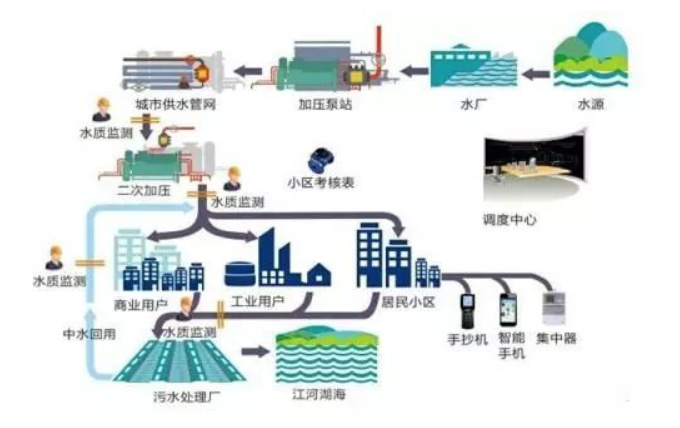
As an integral part of smart cities, smart water services must fully leverage advanced technologies such as IoT, cloud computing, data warehousing, and intelligent decision support, and combine them with hydraulic, hydrological and other models. Only by realizing more pre-judgment, early warning and forecasting functions, and transforming the traditional post-problem-solving working mode into a new model featuring pre-judgment analysis, rapid response, efficient disposal and transparent processes, can we enhance the operational and regulatory capabilities of water supply services, realize the intelligent operation of urban water supply, and improve the management and service level of water supply enterprises.